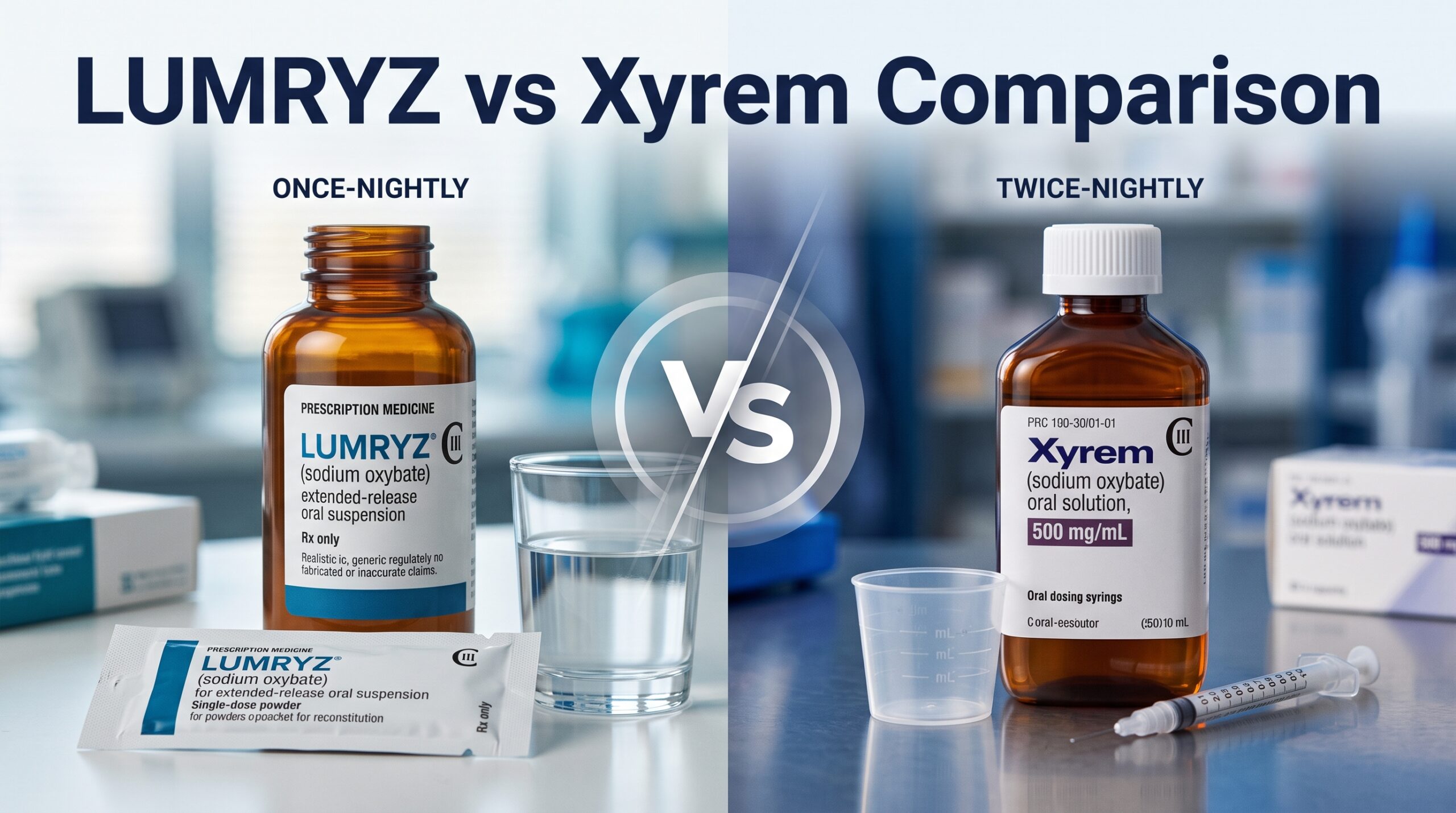
Two medicines. One active ingredient. Very different nights.
If you or someone you love lives with narcolepsy, you may have heard about both LUMRYZ and Xyrem. They look similar on paper. Both contain sodium oxybate. Both treat cataplexy and excessive daytime sleepiness. Yet the way you take them is quite different.
This LUMRYZ vs Xyrem comparison walks you through the main differences in plain language. You will see how dosing, form, sodium content, safety, and daily life compare. You will also learn what to ask your doctor. The final choice is always a medical decision, so use this guide as a starting point for that conversation.
The Short Answer: LUMRYZ vs Xyrem at a Glance
Here is the quick view before we go deeper.
| Feature | LUMRYZ | Xyrem |
|---|---|---|
| Active ingredient | Sodium oxybate | Sodium oxybate |
| Release type | Extended-release (with an immediate-release part) | Immediate-release |
| Form | Powder packet mixed with water | Oral liquid solution |
| Doses per night | One | Two |
| Middle-of-night dose | Not needed | Required |
| Approved for | Cataplexy or EDS in narcolepsy | Cataplexy or EDS in narcolepsy |
| Age group | Adults and children 7+ | Adults and children 7+ |
| Boxed warning | Yes | Yes |
| REMS program | Yes | Yes |
| Sodium content | High (similar per gram) | High |
Main takeaway: The biggest difference is the dosing schedule. LUMRYZ is taken once at bedtime. Xyrem is taken twice, with the second dose a few hours later.
What Is Xyrem?
Xyrem was the first sodium oxybate medicine approved for narcolepsy. It has been used for many years and has a long track record in clinical practice.
How Xyrem Works
Xyrem is a central nervous system (CNS) depressant. It deepens nighttime sleep. Over time, this may reduce cataplexy attacks and daytime sleepiness. Researchers do not fully understand the exact way it works.
How Xyrem Is Taken
- Mix each dose with water in a provided container.
- Take the first dose at bedtime while sitting in bed.
- Lie down right away.
- Take the second dose about 2.5 to 4 hours later, using an alarm.
- Lie back down and stay in bed.
Who Uses Xyrem?
Adults and children aged seven and older with narcolepsy may use it under medical supervision. Authorized generic versions of sodium oxybate oral solution also exist.
What Is LUMRYZ?
LUMRYZ is a newer sodium oxybate product. It was designed to give the same type of active medicine in a once-nightly format.
How LUMRYZ Works
LUMRYZ contains both immediate-release and extended-release particles. The immediate part starts working soon after you take it. The extended part releases medicine later in the night.
How LUMRYZ Is Taken
- Take it at bedtime, at least two hours after eating.
- Mix the packet with water in the provided container.
- Drink the dose while sitting in bed.
- Lie down right away and stay in bed.
There is no second dose to take.
Key Difference 1: Dosing Schedule
This is the most noticeable difference for daily life.
Xyrem: Two Doses
People on Xyrem must wake up for the second dose. That means setting an alarm and breaking sleep. Bed partners and caregivers may be woken as well.
Possible Downsides
- Interrupted sleep
- Risk of oversleeping the second dose
- Added stress for shift workers and parents
- Extra planning at night
Possible Upsides
- Long-established routine
- Familiar to many doctors and patients
- Flexible timing within the approved window
LUMRYZ: One Dose
LUMRYZ removes the middle-of-the-night step.
Possible Upsides
- Uninterrupted sleep for many people
- Easier routine
- Less chance of a missed second dose
- Simpler for caregivers
Possible Downsides
- Newer on the market, with less real-world history
- Dose adjustments are made as one dose, so changes must be planned with your doctor
- Requires waiting at least two hours after eating
Key Difference 2: Form and Preparation
Xyrem Liquid
Xyrem comes as a liquid. You measure it with the supplied syringe and dilute it with water before drinking.
LUMRYZ Powder
LUMRYZ comes as a powder in single-dose packets. You mix the contents with water in the supplied container. It is a simple routine, but you must follow the directions carefully.
Which Is Easier?
This depends on personal taste and habits. Some people prefer a premeasured packet. Others are comfortable with measuring a liquid. Taste and texture are personal, so your experience may differ.
Key Difference 3: Effectiveness
Both medicines contain sodium oxybate. Both have clinical evidence behind them.
Evidence for Xyrem
Over many years, studies showed that Xyrem can:
- Reduce weekly cataplexy attacks
- Improve excessive daytime sleepiness
- Support better daytime function
Evidence for LUMRYZ
In its pivotal trial, once-nightly sodium oxybate extended-release improved:
- Cataplexy attacks
- Ability to stay awake during testing
- Overall clinical status rated by doctors
Is One More Effective?
There is no simple answer. Studies did not compare the two products head-to-head in the same trial. Results can vary from person to person. Your doctor will judge based on your symptoms, response, and lifestyle.
Key Difference 4: Side Effects and Safety
Because both contain sodium oxybate, their safety profiles are similar.
Common Side Effects (Both)
- Nausea
- Dizziness
- Vomiting
- Headache
- Bedwetting
- Decreased appetite
- Sleepwalking in some people
Serious Risks (Both)
CNS Depression
Both medicines can slow breathing and cause deep sedation, particularly when combined with alcohol or other sedating drugs.
Abuse and Misuse
Sodium oxybate is related to GHB. Misuse can be dangerous and life threatening.
Mood Changes
Depression and suicidal thoughts have been reported. Tell your doctor right away about mood changes.
Parasomnias
Complex sleep behaviors, such as sleepwalking, may occur and can lead to injury.
Does One Have Fewer Side Effects?
No clear winner exists. Side effects depend on the dose, the person, and other medicines. If a particular side effect bothers you, discuss it with your doctor. Do not change doses on your own.
Key Difference 5: Sodium Content
Both LUMRYZ and Xyrem are sodium salts. Both contain a notable amount of sodium.
What Does This Mean?
A typical nightly dose can supply roughly 1,000 mg or more of sodium. That is a large part of the usual daily limit of about 1,500 to 2,300 mg.
Who Should Care Most?
- People with high blood pressure
- People with heart failure
- People with kidney problems
- Anyone on a low-sodium diet
A Lower-Sodium Option
If sodium is a concern, ask your doctor about Xywav. It is a different oxybate product with about 92% less sodium than Xyrem. It may or may not be right for you.
Key Difference 6: Safety Program (REMS)
Both medicines are available only through a REMS program.
What the REMS Requires
- Certified prescribers
- Patient enrollment
- Dispensing through certified pharmacies
- Counseling about safe use and storage
This is not a difference between the two products. It is a shared safeguard.
Key Difference 7: Daily Life Impact
What does each option feel like in real life?
For Shift Workers
A single dose may be easier to fit around changing schedules. Two doses require careful timing every night.
For Parents and Caregivers
Skipping the second dose can mean fewer wake-ups. But a caregiver may still need to supervise, especially for children.
For Students
Sleep quality is important for learning. Fewer interruptions may help some students. Others may do fine with the two-dose routine.
For Travelers
Both medicines need secure storage and planning. Always check rules for traveling with controlled medicines.
For People Who Live Alone
Some people worry about sleeping through the second alarm. A once-nightly option may remove that worry.
Pros and Cons Summary
LUMRYZ
Pros
- One dose at bedtime
- No middle-of-night alarm
- Convenient for many routines
Cons
- Newer, with a shorter real-world track record
- High sodium content
- Must avoid eating for two hours before the dose
Xyrem
Pros
- Long history of use
- Well-known to doctors
- Flexible adjustments between two doses
Cons
- Requires waking for a second dose
- Risk of missing the second dose
- High sodium content
How Doctors Decide Between Them
There is no one-size-fits-all answer. Doctors often consider:
- Your symptoms: cataplexy, daytime sleepiness, or both.
- Your health conditions: heart, kidney, breathing, mood, and substance use history.
- Your lifestyle: work hours, family, and sleep habits.
- Your past treatments: what worked and what did not.
- Practical factors: insurance coverage and pharmacy access.
Can You Switch Between Them?
Switching should only happen under medical guidance. The dose and schedule may need to be changed. Never switch or combine products on your own.
Questions to Ask Your Doctor
Bring these to your next visit:
- Would once-nightly dosing suit my life?
- How might switching change my dose?
- What are the sodium concerns for my health?
- Is a lower-sodium option worth considering?
- How will we measure whether the new medicine works?
- What side effects should I report quickly?
- Does my insurance cover each option?
Safety Rules That Apply to Both
Avoid Alcohol Completely
Alcohol plus sodium oxybate can cause dangerous drowsiness and breathing problems.
Avoid Other Sedatives Unless Approved
Sleep pills, opioids, and some other medicines may add risk. Always share your full medicine list.
No Driving After Dosing
Do not drive or operate machinery after taking a dose. Wait until you know how it affects you.
Store Securely
Keep the medicine locked and away from children and visitors.
Never Share
Sharing a controlled medicine is dangerous and illegal.
Common Myths in the LUMRYZ vs Xyrem Debate
Myth 1: “They are completely different drugs.”
Both contain sodium oxybate. The main difference is how the medicine is released and taken.
Myth 2: “Once-nightly is always better.”
Not for everyone. The best choice depends on your health, response, and preferences.
Myth 3: “Extended-release has less sodium.”
No. The sodium is part of the active ingredient in both products.
Myth 4: “One is much safer than the other.”
Both carry similar boxed warnings and need careful use.
Conclusion
The LUMRYZ vs Xyrem comparison comes down to one big idea. Same type of medicine, different experience.
Quick recap:
- Both contain sodium oxybate and treat cataplexy and daytime sleepiness in narcolepsy.
- LUMRYZ is a once-nightly extended-release powder.
- Xyrem is a two-dose liquid.
- Both carry boxed warnings, contain significant sodium, and require a REMS.
- The better choice depends on your health, lifestyle, and doctor’s advice.
If your nighttime routine feels hard, speak with your sleep specialist. Bring your questions, your sleep history, and your daily needs. Together you can choose the best path for your care.
FAQ
What is the main difference between LUMRYZ and Xyrem?
LUMRYZ is an extended-release sodium oxybate medication taken once at bedtime. It is designed to release the medicine gradually throughout the night. Xyrem is an immediate-release sodium oxybate medication that is typically taken in two doses during the night. The main difference is the dosing schedule and how the medication releases its active ingredient. Both are used to treat certain symptoms of narcolepsy, including cataplexy and excessive daytime sleepiness, in eligible patients.
Is LUMRYZ stronger than Xyrem?
Not necessarily. Both medications contain sodium oxybate, but their release mechanisms and dosing schedules differ. A higher or lower prescribed dose does not automatically mean one medication is stronger or more effective than the other. Individual responses can vary depending on symptoms, medical history, and tolerability. A healthcare professional should determine which option is appropriate for each patient.
Do LUMRYZ and Xyrem have the same side effects?
Their side effects are generally similar because both medications contain the same active ingredient, sodium oxybate. Common side effects may include nausea, dizziness, headache, vomiting, and bedwetting. Both medications also carry serious risks, including respiratory depression, impaired consciousness, and misuse or abuse. Alcohol and certain sedating medications can increase these risks. Patients should discuss potential side effects and safety precautions with their healthcare provider before starting treatment.
Which has less sodium, LUMRYZ or Xyrem?
LUMRYZ and Xyrem are both sodium oxybate formulations and can contribute a substantial amount of sodium to a person’s daily intake. The precise amount depends on the prescribed dose and the specific formulation. Neither should automatically be considered a low-sodium alternative to the other. Xywav is another oxybate medication formulated with calcium, magnesium, potassium, and sodium oxybates and contains substantially less sodium. Patients with high blood pressure, heart conditions, kidney problems, or dietary sodium restrictions should ask their healthcare provider about suitable options.
Can I switch from Xyrem to LUMRYZ?
Switching from Xyrem to LUMRYZ may be possible for some patients, but it requires medical supervision. Although both medications contain sodium oxybate, their release characteristics and administration schedules differ. A healthcare professional must determine the appropriate transition plan and explain how to take the new medication safely. Patients should not independently change their dose, combine the medications, or stop their prescribed treatment without medical guidance. Any concerns about side effects or nighttime dosing should be discussed with the prescribing clinician.
Do I need a REMS enrollment for both?
Yes. Both LUMRYZ and Xyrem are subject to a restricted Risk Evaluation and Mitigation Strategy (REMS) program because sodium oxybate can cause serious safety problems. Access generally requires an appropriately certified prescriber and a certified pharmacy operating under the applicable program requirements. Patients may need to complete enrollment and receive medication-specific safety information before treatment begins. These restrictions help reduce the risks of misuse, accidental exposure, and dangerous interactions with other substances. Patients should confirm the current enrollment requirements with their healthcare provider or dispensing pharmacy.
Is LUMRYZ easier to take than Xyrem?
For some patients, LUMRYZ may be more convenient because it is designed to be taken as a single dose at bedtime rather than requiring a second dose later in the night. This may reduce the need to wake up to take another dose. However, LUMRYZ still requires careful adherence to the prescribed administration instructions and is generally taken at least two hours after eating. Patients must also follow instructions for preparing and taking the medication. Whether it is easier depends on an individual’s sleep schedule, daily routine, and treatment needs.
Can children use LUMRYZ or Xyrem?
Both LUMRYZ and Xyrem are approved in the United States for certain narcolepsy symptoms in pediatric patients aged seven years and older. Treatment must be supervised by a qualified healthcare professional who can assess the child’s symptoms, medical history, and individual needs. Dosing in children is based on factors such as body weight and must follow the medication’s official prescribing information. Caregivers should monitor for side effects and follow all storage and administration instructions carefully. The decision to use either medication should be made by the child’s healthcare team after considering the potential benefits and risks.