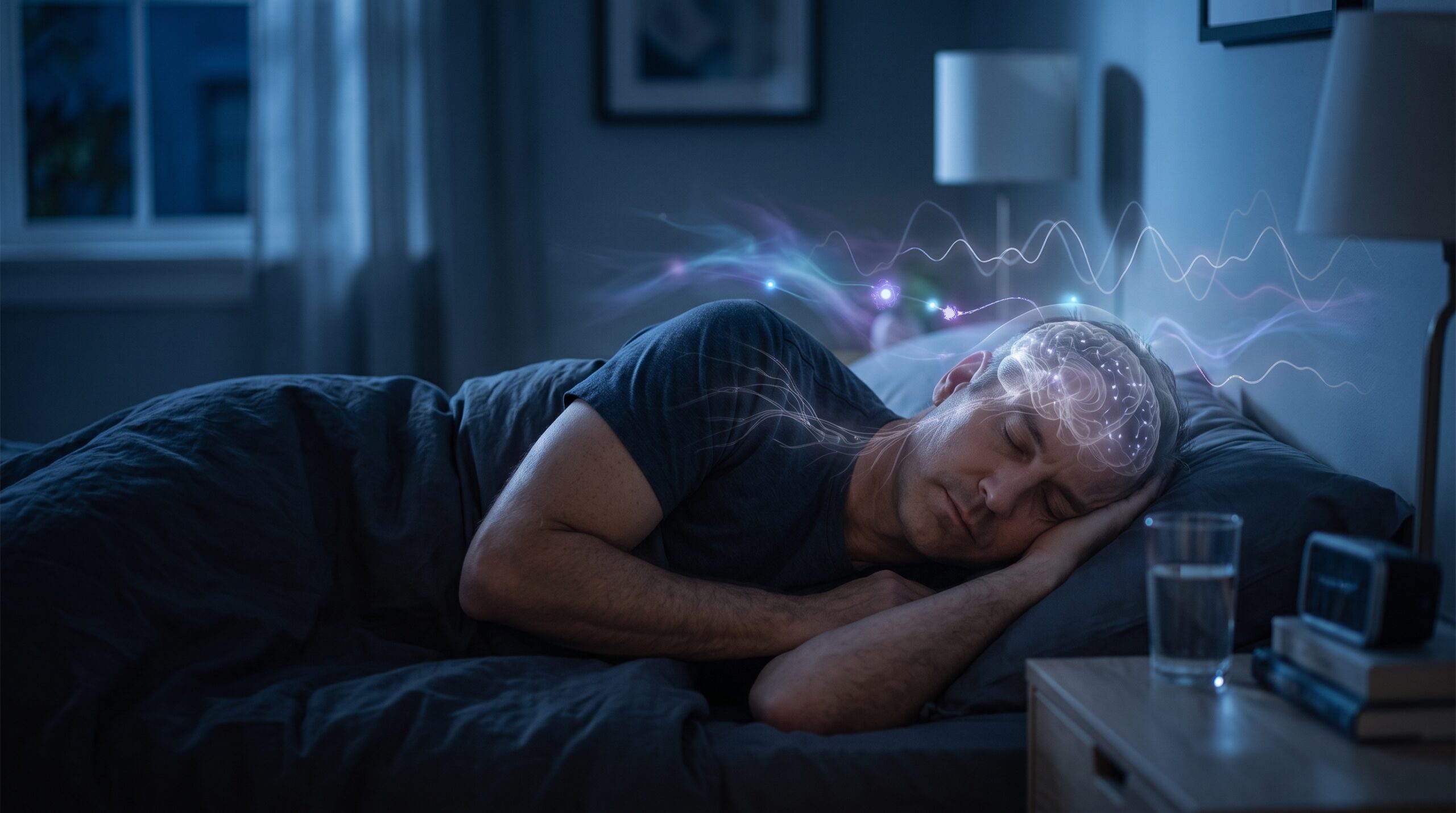
Have you ever wondered why someone with narcolepsy can fall asleep in the middle of a conversation and start dreaming vividly within sixty seconds—or why laughing at a joke can suddenly make their knees buckle while they are wide awake? To the outside observer, narcolepsy looks like a simple problem of “sleeping too much.” In reality, narcolepsy is not a disorder of excessive sleep quantity; it is a profound neurological disorder of sleep stage boundaries.
When patients and students ask, “What stage of sleep does narcolepsy occur?”, the primary culprit is Rapid Eye Movement (REM) sleep—alongside a severe destabilization of the transition between wakefulness and Non-Rapid Eye Movement (NREM) sleep.
In a healthy brain, sleep unfolds like a carefully choreographed symphony, marching step-by-step through light sleep and deep slow-wave sleep before finally unlocking the vivid, paralyzed world of REM sleep after 90 minutes. In a brain with narcolepsy, that choreography collapses. REM sleep breaks free from its nighttime cage, crashing directly into waking life and launching within minutes of closing your eyes.
In this comprehensive guide, we will break down the exact stages of normal human sleep architecture, explain how narcolepsy hijacks the REM sleep stage, explore the phenomenon of Sleep-Onset REM Periods (SOREMPs), and examine how detached fragments of REM sleep cause cataplexy, sleep paralysis, and hallucinations.
A Quick Primer: The 4 Stages of Normal Sleep Architecture
Before we can understand what goes wrong in narcolepsy, we first need to look at how a healthy human brain cycles through sleep. Every night, your brain progresses through four distinct stages divided into two main categories: NREM (Non-Rapid Eye Movement) sleep and REM (Rapid Eye Movement) sleep. One complete sleep cycle takes roughly 90 to 110 minutes and repeats four to six times per night.
Stage 1: NREM 1 (N1) – The Twilight Transition
- What happens: N1 is the lightest stage of sleep, lasting only 1 to 7 minutes as you drift off. Your breathing slows, your heartbeat regularizes, and your brain waves shift from wakeful alpha waves to slower theta waves.
- Muscle tone: You still maintain normal muscle tone, though you may experience a sudden “hypnic jerk” (feeling like you are falling).
Stage 2: NREM 2 (N2) – Light, Restorative Sleep
- What happens: You spend roughly 45% to 55% of your total night in N2 sleep. Your body temperature drops, eye movements stop, and your brain produces signature electrical bursts called sleep spindles and K-complexes, which guard your sleep against external noises and help consolidate declarative memories.
Stage 3: NREM 3 (N3) – Deep Slow-Wave Sleep (Delta Sleep)
- What happens: Also known as slow-wave sleep (SWS) or delta sleep, N3 is the deepest, most physically restorative stage of sleep. Your brain produces high-amplitude, slow delta waves. During N3, your body repairs tissues, releases human growth hormone, strengthens the immune system, and flushes metabolic waste from the brain via the glymphatic system.
Stage 4: REM Sleep – The Dreaming & Paralyzed Stage
- What happens: In a healthy sleeper, the very first REM stage does not occur until 80 to 110 minutes after falling asleep, only after the brain has completed N1, N2, and N3.
- Brain activity: During REM sleep, your brain waves speed right back up, looking almost identical to an awake brain on an EEG (which is why REM is often called paradoxical sleep). Your eyes dart rapidly beneath your eyelids, your breathing and heart rate become irregular, and vivid, narrative dreaming takes place.
- REM Muscle Atonia: To prevent you from physically acting out your dreams and hurting yourself, specialized nuclei in your brainstem send inhibitory signals (via GABA and glycine neurotransmitters) down your spinal cord to completely paralyze your voluntary skeletal muscles. Only your diaphragm (for breathing) and eye muscles remain active.
What Stage of Sleep Does Narcolepsy Occur In? The Core Answer
Narcolepsy primarily occurs as a dysregulation and intrusion of the REM sleep stage, paired with an unstable boundary across all NREM stages (N1, N2, and N3) and wakefulness.
Rather than staying confined to the end of a 90-minute nocturnal sleep cycle, REM sleep in narcolepsy behaves unpredictably in three specific ways:
- Instantaneous Entry into REM Sleep (SOREMPs): Instead of spending 90 minutes progressing through N1, N2, and N3 before reaching REM, a person with narcolepsy frequently bypasses deep NREM sleep altogether—dropping straight from wakefulness or a few seconds of Stage N1 directly into full-blown REM sleep within 0 to 15 minutes.
- REM Sleep Intrusion into Wakefulness: The distinct physiological features of the REM sleep stage—specifically vivid dreaming and REM muscle paralysis (atonia)—spill over into the waking state. When REM muscle paralysis occurs while you are awake and laughing, it is called cataplexy. When it occurs as you wake up or fall asleep, it is sleep paralysis.
- Fragmentation of NREM Slow-Wave Sleep (Stage N3): Because the brain’s sleep-wake switch is unstable, people with narcolepsy also struggle to stay inside deep Stage N3 sleep at night, experiencing frequent micro-arousals and abrupt jumps between Stage R (REM), Stage N1, and wakefulness.
| Sleep Architecture Feature | Healthy Sleeper (Normal Architecture) | Person with Narcolepsy (Narcoleptic Architecture) |
|---|---|---|
| Sleep Latency (Time to fall asleep) | 10 to 20 minutes | Under 8 minutes (often 1 to 3 minutes) |
| Entry Sequence | Wake → N1 → N2 → N3 → REM | Wake → Brief N1 → Immediate REM |
| REM Latency (Time to first REM stage) | 80 to 110 minutes | ≤ 15 minutes (SOREMP) |
| Boundary Between Wake & REM | Strictly separated by NREM stages | Blurred; REM dreams & paralysis intrude into wakefulness |
| Nighttime Sleep Continuity | Consolidated cycles with sustained N3 | Highly fragmented; frequent waking & stage shifting |
| Total 24-Hour Sleep Amount | 7 to 9 hours | Roughly normal (7 to 9 hours spread across day & night) |
Understanding SOREMPs: Sleep-Onset REM Periods Explained
In clinical sleep medicine, the signature electrical hallmark of narcolepsy is the SOREMP, which stands for Sleep-Onset REM Period.
What Is a SOREMP?
A SOREMP is medically defined as entering the REM stage of sleep within 15 minutes or less of falling asleep (as measured from the first epoch of sleep on an electroencephalogram). In many patients with Narcolepsy Type 1, REM latency is even shorter—sometimes occurring within 1 to 3 minutes of closing their eyes.
Why Do SOREMPs Happen during Daytime Naps and Nighttime Sleep?
Under normal physiological conditions, entering REM sleep requires hours of buildup and the completion of slow-wave NREM sleep. However, in narcolepsy, the brain’s REM-off switch is broken.
- At Night: When a person with narcolepsy lies down in bed at 10:30 PM, they often drop into REM sleep by 10:35 PM.
- During Daytime Sleep Attacks: When a person with narcolepsy experiences an irresistible daytime sleep attack and takes a 15-minute nap at their desk, their brain immediately plunges into REM sleep. This explains why people with narcolepsy frequently report having vivid, complex, movie-like dreams during a 5-to-10-minute power nap!
In fact, detecting two or more SOREMPs during a daytime Multiple Sleep Latency Test (MSLT)—or one daytime SOREMP plus one overnight SOREMP—is one of the primary diagnostic criteria required by sleep specialists to officially diagnose narcolepsy.
The Neuroscience: Why the Brain’s “Flip-Flop Switch” Fails
Why does a narcoleptic brain skip the normal NREM staircase and plunge straight into REM sleep? The answer lies in a tiny, almond-sized region deep inside the brain called the hypothalamus, and a revolutionary neurological model developed by Harvard neuroscientist Dr. Clifford Saper known as the Sleep-Wake Flip-Flop Switch.
1. The Wake-Promoting and Sleep-Promoting Centers
Think of your brain’s sleep-wake system like a traditional light switch on the wall.
- On one side of the switch are wake-promoting nuclei (located in the brainstem and basal forebrain) that release alerting neurotransmitters like dopamine, norepinephrine, serotonin, acetylcholine, and histamine.
- On the other side of the switch is the sleep-promoting center (the ventrolateral preoptic nucleus, or VLPO), which releases inhibitory GABA to turn off the waking brain so you can sleep.
- A second, similar flip-flop switch in the brainstem controls REM-on versus REM-off neurons.
2. Hypocretin (Orexin): The Finger Holding the Switch in Place
In a healthy brain, these two sides mutually inhibit each other so that you are either 100% awake or 100% asleep, never stuck in the middle. What keeps the switch firmly locked in the “Awake” position all day long and prevents the “REM-on” switch from flipping by accident?
The stabilizer is hypocretin (also called orexin), a neuropeptide produced by roughly 70,000 specialized neurons in the lateral hypothalamus. Hypocretin acts like a strong spring or a firm finger pressing Down on the “Wake” and “REM-off” switches throughout the day.
3. What Happens When Hypocretin Is Lost
In Narcolepsy Type 1, an autoimmune process destroys 85% to 95% of these hypocretin-producing neurons. Without hypocretin holding the switch steady:
- The flip-flop switch becomes loose and unstable, flickering rapidly back and forth at the slightest nudge.
- During the day, the switch suddenly flips from Wake straight to Sleep (causing a daytime sleep attack).
- Simultaneously, because hypocretin normally excites the monoaminergic neurons (norepinephrine and serotonin) that suppress REM sleep, losing hypocretin removes the brakes on the REM-on center in the pons (specifically the sublaterodorsal nucleus). As a result, the moment you close your eyes—or the moment you laugh—the REM switch flips on prematurely.
How REM Stage Dissociation Creates the Classic Narcolepsy Symptoms
Sleep neurologists describe narcolepsy as a disorder of state boundary control or REM sleep dissociation. In simple terms, the elements that belong strictly inside the REM sleep stage—dreaming and muscle paralysis—break apart and invade the transition zones between wakefulness and Stage N1 sleep.
Let’s examine how each classic narcolepsy symptom is directly tied to the REM sleep stage:
1. Cataplexy: REM Muscle Paralysis Intruding into Full Wakefulness
During normal REM sleep, your brainstem activates motor-inhibition pathways so your body stays safely paralyzed while you dream. In people with Narcolepsy Type 1, strong emotional stimuli—like roaring with laughter, hearing a witty punchline, feeling sudden pride, or getting startled—activate the amygdala (the brain’s emotional center).
In a healthy brain, hypocretin buffers this emotional signal. Without hypocretin, the amygdala directly triggers the brainstem’s REM-atonia circuit while the cerebral cortex remains 100% wide awake. Within a split second, the person experiences bilateral muscle weakness—their jaw drops, their head nods, or their knees buckle to the floor—because their spinal cord thinks they just entered the REM sleep stage, even though their eyes are open and their mind is fully conscious.
2. Sleep Paralysis: Getting Stuck Between REM and Wakefulness
When waking up from a REM sleep stage (or dropping directly into a SOREMP while falling asleep), the brain’s consciousness switch and muscle-tone switch fail to synchronize.
- Your cerebral cortex wakes up first, making you fully aware that you are lying in your bedroom.
- However, your brainstem remains locked in the REM sleep stage, continuing to enforce REM muscle atonia for another 30 seconds to 3 minutes. You cannot lift a finger, turn your head, or call out for help until the REM stage fully terminates.
3. Hypnagogic and Hypnopompic Hallucinations: Dreaming With Your Eyes Open
Have you ever wondered why narcolepsy hallucinations are so vivid and terrifying? Because they are literally REM stage dreams projected onto a waking room.
- Hypnagogic hallucinations occur while falling asleep; hypnopompic hallucinations occur while waking up.
- These multi-sensory hallucinations can be visual, auditory, or tactile—such as seeing a shadowy figure standing in the bedroom doorway, hearing footsteps or voices, or feeling as though someone is touching the bed. Because they feel terrifyingly real, adults are sometimes mistakenly referred to psychiatrists before seeing a sleep specialist.
Does Narcolepsy Affect Non-REM (NREM) Sleep Stages Too?
While REM sleep gets most of the spotlight, it is a misconception that narcolepsy only affects the REM stage. Decades of polysomnography research show that narcolepsy also significantly disrupts NREM sleep stages (N1, N2, and N3):
1. Rapid Collapse of Stage N1 and N2 during the Day
During daytime excessive sleepiness (EDS), not every micro-sleep or nap is pure REM sleep. Throughout the day, a person with narcolepsy constantly battles the intrusion of Stage N1 (drowsy theta waves) and Stage N2 into their waking brain waves. This waxing and waning of Stage N1 into wakefulness causes:
- Severe “brain fog” and difficulty concentrating.
- Microsleeps: Brief 3-to-15-second intrusions of Stage N1 sleep where the person stares blankly and misses parts of a lecture or conversation.
- Automatic Behavior: Continuing to write, type, or walk while the brain is hovering in a twilight mix of Wake and Stage N1 sleep.
2. Loss and Fragmentation of Deep Slow-Wave Sleep (Stage N3)
In a normal sleeper, the first third of the night is dominated by long, uninterrupted stretches of Stage N3 (deep delta sleep). In a person with narcolepsy:
- Because the brain jumps immediately into a SOREMP at the start of the night, the initial bout of Stage N3 slow-wave sleep is delayed or cut short.
- Throughout the second half of the night, slow-wave sleep rapidly dissipates, and the sleeper experiences frequent transitions from REM or N2 straight back to Wakefulness or Stage N1.
- Consequently, people with narcolepsy spend a much higher percentage of their night in light Stage N1 sleep and wake up feeling as though they tossed and turned all night—even though they fell asleep instantly at bedtime.
How Sleep Studies Track Sleep Stages to Diagnose Narcolepsy
Because narcolepsy is defined by when and how fast you enter specific stages of sleep, sleep specialists rely on two objective neurophysiological tests to map your sleep stages epoch by epoch (in 30-second intervals):
1. Overnight Polysomnography (PSG) Hypnogram
During an overnight sleep study, electrodes pasted to your scalp (EEG), outer eyes (EOG), and chin (EMG) record your sleep architecture and plot it on a graph called a hypnogram.
- In a healthy hypnogram, the line steps smoothly downward from Wake → N1 → N2 → N3, staying in deep N3 sleep for a long block before rising to the first REM bar around the 90-minute mark.
- In a narcolepsy hypnogram, the line plummets straight from Wake to the REM bar within the first 15 minutes (an overnight SOREMP), followed by a jagged, sawtooth pattern of frequent nighttime awakenings and fragmented N2/N3 blocks.
2. Multiple Sleep Latency Test (MSLT) Stage Scoring
The next morning, during the five scheduled 20-minute naps of the MSLT, sleep technologists watch the live EEG, EOG, and EMG screens for two specific stage markers:
- Sleep Onset (Usually Stage N1): Marked by the disappearance of posterior alpha waves and the emergence of low-amplitude, mixed-frequency theta waves and slow rolling eye movements. If the average time to hit this first sleep stage across five naps is ≤ 8 minutes, abnormal daytime sleep drive is confirmed.
- REM Stage Onset (SOREMP): Marked by low-voltage sawtooth brain waves, rapid conjugate eye movements on the EOG channels, and a complete flatlining of chin muscle tone (chin EMG atonia). Hitting this REM stage in at least 2 of the 5 naps confirms that REM sleep is occurring prematurely.
Conclusion
So, what stage of sleep does narcolepsy occur in? At its core, narcolepsy is a disorder of Rapid Eye Movement (REM) sleep regulation and unstable wake-NREM-REM transitions. Due to the loss or dysfunction of hypocretin signaling in the hypothalamus, the brain’s “flip-flop switch” can no longer keep REM sleep locked at the end of a 90-minute nighttime cycle.
Instead, individuals with narcolepsy plunge into Sleep-Onset REM Periods (SOREMPs) within minutes of falling asleep, experience dissociated pieces of REM sleep (like muscle paralysis and dreams) while wide awake, and suffer from fragmented deep slow-wave (Stage N3) sleep at night. Understanding that narcolepsy is a neurobiological boundary disorder—rather than simple laziness or poor sleep habits—empowers patients to seek accurate sleep stage testing and targeted medical treatment.
FAQ
1. Do people with narcolepsy skip NREM sleep completely and go straight to REM?
Almost, though technically they usually pass through a very brief period (often just 30 seconds to a few minutes) of light Stage N1 (and occasionally brief N2) sleep before dropping straight into REM sleep. In a healthy sleeper, the brain must complete N1, N2, and deep N3 sleep (taking ~90 minutes) before entering REM; in narcolepsy, the brain skips deep N3 sleep at the start of a nap and enters REM within 15 minutes (a SOREMP).
2. Why do I dream immediately during a 10-minute nap?
Dreaming immediately during a short power nap is a classic sign of a Sleep-Onset REM Period (SOREMP). While most vivid narrative dreams occur during REM sleep—which normally takes 90 minutes to reach—people with narcolepsy (or severe REM sleep deprivation) enter the REM stage within minutes of closing their eyes, resulting in instant, vivid dreams.
3. Does narcolepsy occur during deep sleep (Stage N3)?
Narcolepsy does not originate in deep Stage N3 sleep, wait-states, or sleepwalking (which is an N3 parasomnia). However, narcolepsy negatively affects Stage N3 sleep by fragmenting it. Because the brain’s sleep-wake switch is unstable, people with narcolepsy wake up frequently throughout the night and struggle to maintain long, consolidated blocks of deep slow-wave sleep.
4. Can you have REM sleep while awake if you have narcolepsy?
Yes—in a partial or “dissociated” form. Both cataplexy (sudden muscle weakness triggered by emotions) and hypnagogic hallucinations (vivid waking dreams) are literal physiological components of the REM sleep stage intruding into your waking consciousness while your eyes are open.
5. Do both Narcolepsy Type 1 and Type 2 involve early REM sleep stages?
Yes. Both Narcolepsy Type 1 (with cataplexy) and Narcolepsy Type 2 (without cataplexy) are diagnosed using the same MSLT criteria: falling asleep in an average of 8 minutes or less and entering the REM sleep stage within 15 minutes (SOREMPs) at least twice during daytime testing.