Narcolepsy is a chronic neurological sleep disorder that affects the brain’s ability to regulate sleep and wakefulness. People with narcolepsy may experience excessive daytime sleepiness, difficulty staying awake, disrupted nighttime sleep, and sudden transitions into sleep. These symptoms can interfere with daily activities, concentration, education, work, and overall quality of life. Because several other sleep disorders can cause similar symptoms, obtaining an accurate diagnosis is essential for choosing appropriate treatment and support.
One of the most important tests used to evaluate suspected narcolepsy is the Multiple Sleep Latency Test, commonly known as the MSLT. This daytime sleep study measures how quickly a person falls asleep under controlled conditions and whether rapid eye movement (REM) sleep occurs unusually early. Doctors interpret these findings alongside a patient’s symptoms, medical history, sleep schedule, and overnight sleep study results.
Understanding what to expect during a narcolepsy sleep study (MSLT) can make the testing process less stressful. Knowing how to prepare, what happens during each nap opportunity, how the results are evaluated, and what happens afterward can help patients approach the assessment with greater confidence.
What Is a Narcolepsy Sleep Study (MSLT)?
The Multiple Sleep Latency Test is a specialized diagnostic procedure used to measure daytime sleepiness and identify unusual patterns of REM sleep. It is commonly performed when a sleep specialist suspects narcolepsy or another condition associated with excessive daytime sleepiness.
During the test, patients are given several scheduled opportunities to sleep in a quiet, darkened room. Sensors record brain activity, eye movements, and muscle activity to determine whether sleep occurs and how quickly it begins. The test also identifies whether REM sleep appears shortly after sleep onset.
The MSLT is usually conducted during the day following an overnight polysomnography, which is a comprehensive sleep study performed the previous night. The overnight study helps establish whether the patient obtained adequate sleep and evaluates other sleep disorders that could affect daytime sleepiness.
An MSLT is not simply a test of how tired someone feels. It objectively measures sleep tendencies under standardized conditions. However, its findings must be interpreted carefully because insufficient sleep, medications, irregular sleep schedules, and other medical conditions can influence the results.
Why Is the MSLT Used to Diagnose Narcolepsy?
Narcolepsy affects the brain systems responsible for maintaining alertness and coordinating sleep stages. People with the condition may fall asleep more quickly than expected during the day and may enter REM sleep unusually soon after falling asleep.
The MSLT helps clinicians identify these patterns. It is particularly useful when a patient reports persistent daytime sleepiness that cannot be adequately explained by their sleep history or other initial evaluations.
The test is often considered alongside an overnight sleep study, a detailed clinical assessment, and information about symptoms such as sleep attacks, disrupted nighttime sleep, sleep paralysis, and hallucinations around sleep transitions. Cataplexy, which involves sudden muscle weakness triggered by emotions, is also an important symptom when evaluating possible narcolepsy.
Although the MSLT provides valuable diagnostic information, it does not independently establish every case of narcolepsy. A sleep specialist considers the complete clinical picture before determining a diagnosis.
Who Needs an MSLT for Narcolepsy?
A sleep specialist may recommend an MSLT when someone experiences persistent excessive daytime sleepiness despite having an opportunity to obtain sufficient nighttime sleep. The test is especially relevant when narcolepsy is suspected after reviewing the person’s symptoms and sleep history.
Excessive daytime sleepiness is the central concern in narcolepsy evaluations. Patients may struggle to remain awake during normal daily activities, feel an overwhelming need to sleep, or experience repeated episodes of unintended sleep. These symptoms can occur even when nighttime sleep appears adequate.
However, daytime sleepiness can also result from obstructive sleep apnea, insufficient sleep, circadian rhythm disorders, medication effects, and other medical conditions. A sleep specialist evaluates these possibilities before deciding whether an MSLT is appropriate.
The test may also be used when the diagnosis remains uncertain after an initial assessment. Its results can help distinguish narcolepsy from other causes of abnormal daytime sleepiness, although some conditions require additional investigation.
Symptoms That May Lead to an MSLT
People undergoing an MSLT frequently report difficulty maintaining alertness during the day. They may experience persistent fatigue, repeated urges to sleep, reduced concentration, or difficulty functioning normally despite attempts to maintain a consistent sleep schedule.
Other symptoms can provide important diagnostic clues. Sleep paralysis involves temporary difficulty moving when falling asleep or waking up, while sleep-related hallucinations occur around transitions between sleep and wakefulness. Cataplexy is particularly relevant because it is strongly associated with narcolepsy type 1.
Not everyone with narcolepsy experiences every symptom. Some individuals primarily experience excessive daytime sleepiness, while others report several additional sleep-related difficulties. This variation makes a thorough assessment important.
A healthcare professional should evaluate persistent or unexplained sleepiness rather than relying on symptoms alone. The MSLT is one component of a broader diagnostic process designed to identify the underlying cause.
How to Prepare for a Narcolepsy Sleep Study
Preparation is an essential part of an accurate MSLT. Sleep duration, medication use, caffeine consumption, and the timing of sleep can influence how quickly someone falls asleep during testing. Following the sleep clinic’s instructions helps reduce factors that could distort the findings.
Patients should receive specific preparation instructions from their sleep specialist. These instructions may include keeping a consistent sleep schedule, recording sleep patterns, reviewing medications, and avoiding substances that could affect sleep or alertness.
It is important not to change prescribed medication independently. Some medicines influence REM sleep or daytime alertness, and stopping them suddenly may be unsafe. The clinician should determine whether a medication adjustment is necessary and explain how to approach it safely.
Maintaining a Consistent Sleep Schedule
Obtaining sufficient sleep before an MSLT is important because sleep deprivation can produce abnormal daytime sleepiness. A person who regularly sleeps too little may fall asleep quickly during the test even without having narcolepsy.
Sleep specialists commonly recommend maintaining a regular bedtime and wake-up time in the days leading up to testing. The appropriate sleep duration depends on individual needs, but the goal is to ensure adequate and consistent rest.
Patients may be asked to complete a sleep diary for approximately two weeks before the study. Some may also undergo actigraphy, which uses a wearable device to estimate sleep and wake patterns over time.
These records help the clinician determine whether the patient’s usual sleep schedule could affect the results. Adequate preparation improves the reliability of the assessment and reduces the likelihood of needing repeat testing.
Reviewing Medications and Substances
Certain prescription medications, over-the-counter products, and substances can affect alertness, sleep duration, or REM sleep. Stimulants, sedatives, antidepressants, and other medicines may influence the results depending on their effects and how they are used.
Patients should provide a complete list of their medications and supplements to the sleep specialist. The clinician will decide whether any changes are appropriate before testing and explain the timing of those changes when necessary.
Caffeine, nicotine, alcohol, and other substances may also affect sleep or wakefulness. Patients should follow the laboratory’s specific instructions regarding their use before and during the study.
Medication adjustments should always be medically supervised. In some situations, testing may need to be postponed if preparation requirements cannot be met safely or if the results are likely to be unreliable.
What Happens During an MSLT?
The MSLT typically takes place at a sleep laboratory after an overnight polysomnography. Patients usually remain at the facility throughout the testing period so that technicians can follow a standardized schedule and monitor the recordings.
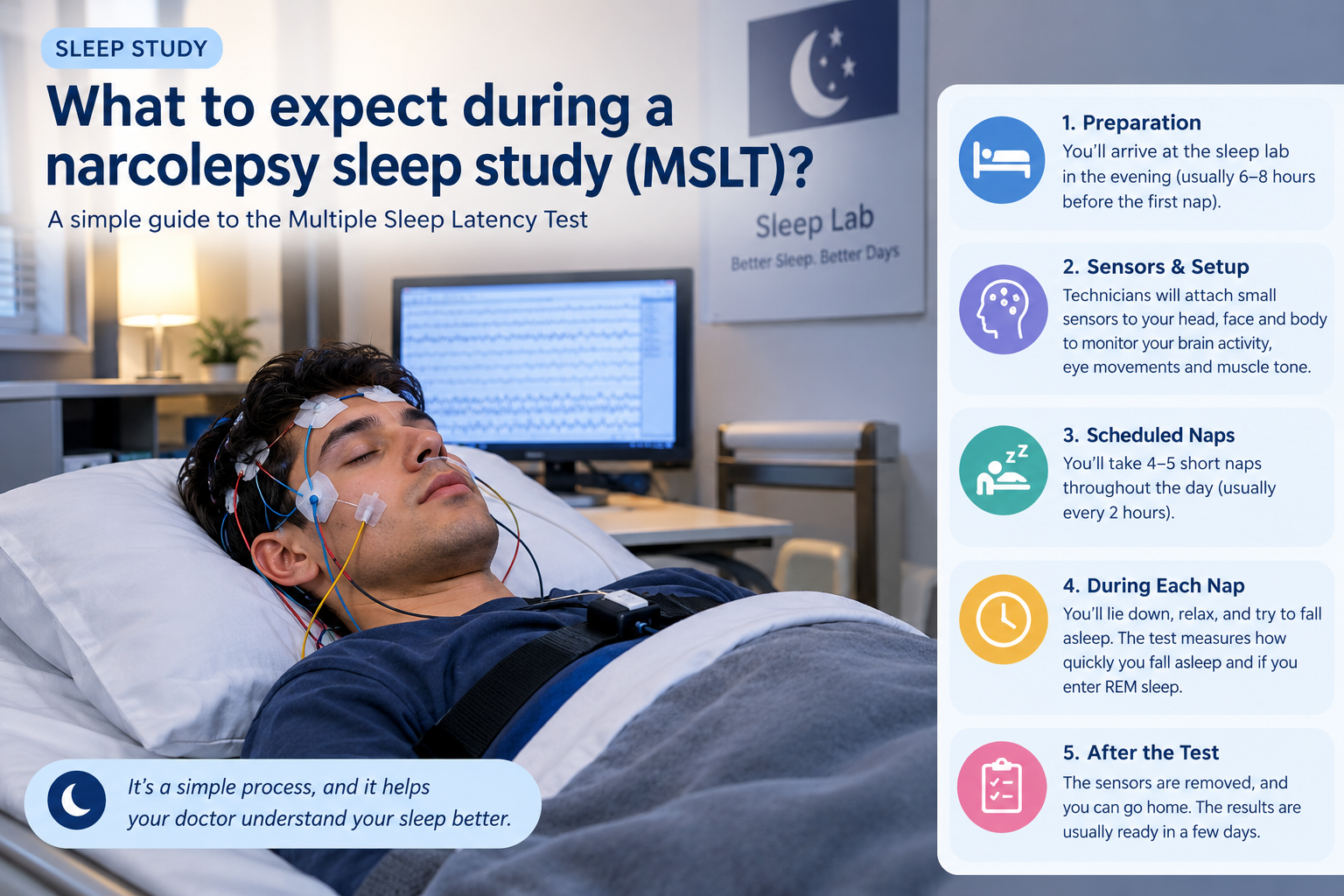
The daytime study generally includes five scheduled nap opportunities, with intervals of approximately two hours between them. In some circumstances, a clinician may determine that a different number of trials is appropriate under the applicable testing protocol.
During each nap opportunity, the patient rests in a quiet room and is instructed to try to fall asleep. Monitoring equipment records physiological signals that help determine when sleep begins and whether REM sleep occurs.
The technician follows standardized procedures throughout the study. Between nap trials, patients are generally expected to remain awake, and they receive instructions about what they may do during the waiting periods.
The Overnight Sleep Study Before the MSLT
An overnight polysomnography is generally required before an MSLT used to evaluate suspected narcolepsy. This study records sleep throughout the night and helps determine whether the patient obtained adequate sleep before daytime testing.
Small sensors are attached to the scalp, face, and other areas of the body. These sensors measure brain activity, eye movements, muscle activity, breathing, oxygen levels, heart rate, and other relevant signals.
The overnight study can identify conditions such as obstructive sleep apnea and other disturbances that may contribute to excessive daytime sleepiness. It also helps clinicians evaluate the timing and structure of nighttime sleep.
The overnight assessment is important because insufficient sleep or an untreated sleep disorder can affect MSLT findings. If the overnight study reveals a problem that could interfere with interpretation, the clinician may recommend addressing it before proceeding with further testing.
What Happens During Each Nap Trial?
During each scheduled nap opportunity, the patient lies down in a quiet, darkened room. The technician provides instructions and confirms that the monitoring equipment is functioning properly before the trial begins.
The patient is usually asked to relax and try to fall asleep. The equipment records brain activity and other signals that show whether sleep occurs and how much time passes before sleep begins.
If the patient falls asleep, the recording continues according to the testing protocol. The study evaluates sleep onset and checks whether REM sleep appears soon after the transition from wakefulness to sleep.
If the patient does not fall asleep during the allotted period, that information is recorded as part of the assessment. The technician then follows the protocol for ending the trial and preparing for the next scheduled opportunity.
The process is repeated throughout the day. Patients do not need to force themselves to fall asleep, and they should follow the technician’s instructions rather than attempting to influence the test.
How Long Does an MSLT Take?
The daytime portion of an MSLT usually lasts most of the day. With five scheduled nap opportunities and intervals between them, testing commonly extends across several hours.
The exact schedule depends on the laboratory’s protocol and the patient’s circumstances. The overnight polysomnography takes place separately on the preceding night, meaning the complete evaluation generally involves an overnight stay followed by daytime testing.
Patients should plan to remain at the facility until the study is completed. They should avoid arranging activities that require sustained alertness immediately afterward if they feel sleepy, and they should follow the clinic’s advice about transportation.
What Does an MSLT Feel Like?
For most patients, an MSLT is noninvasive and does not involve needles or painful procedures. The sensors attached to the body measure sleep-related activity without entering the body.
Some people find the process straightforward, while others may feel uncomfortable sleeping in an unfamiliar environment. The equipment, scheduled naps, and requirement to remain awake between trials can make the day feel unusual.
The test is designed to observe natural sleep tendencies under controlled conditions. Patients should follow the instructions as closely as possible and tell the technician if they experience discomfort or have questions about the procedure.
Can You Fall Asleep During Every Nap?
Not everyone falls asleep during every scheduled nap. Some patients fall asleep during several trials, while others may remain awake during one or more opportunities.
The MSLT measures the time it takes to fall asleep rather than requiring a particular number of successful naps. Remaining awake during a trial is therefore meaningful information, not a personal failure.
Patients should avoid trying to manipulate their results by deliberately staying awake or attempting to fall asleep faster. The most useful findings come from following the standard procedure and allowing the testing team to record the patient’s natural responses.
What Can You Do Between Nap Trials?
The sleep laboratory will explain what activities are permitted between trials. Patients are generally expected to stay awake between nap opportunities so that one trial does not interfere with the next.
Depending on the laboratory’s instructions, patients may be able to read, sit quietly, or engage in other calm activities. They may be asked to avoid vigorous exercise, caffeine, or activities that could affect alertness.
The technician will explain when each trial begins and ends. Patients should ask questions if they are unsure about the schedule or whether a particular activity is permitted.
How Are MSLT Results Interpreted?
After the test, a qualified sleep specialist reviews the recorded data alongside the overnight polysomnography and the patient’s clinical history. The interpretation considers average sleep latency, the occurrence of sleep-onset REM periods, and other factors that may affect the reliability of the results.
The findings are not interpreted in isolation. A person may have abnormal sleepiness for reasons unrelated to narcolepsy, while some patients with suspected narcolepsy may have results that require further evaluation.
The specialist also considers whether the patient obtained sufficient sleep before testing, followed the preparation instructions, and had any medication or medical factors that could influence sleep.
What Is Mean Sleep Latency?
Mean sleep latency is the average amount of time a patient takes to fall asleep across the scheduled nap trials. It provides an objective measure of daytime sleep tendency under the conditions of the test.
A shorter mean sleep latency indicates that the patient falls asleep more quickly. In the appropriate clinical context, unusually short sleep latency may support a diagnosis of narcolepsy or another condition associated with excessive daytime sleepiness.
For narcolepsy, diagnostic criteria generally include a mean sleep latency of eight minutes or less, together with at least two sleep-onset REM periods across the MSLT and the preceding overnight polysomnography combined. The full diagnostic criteria and clinical circumstances must still be considered.
These measurements help clinicians evaluate sleep patterns, but they do not replace a comprehensive assessment. The results must be interpreted in relation to the patient’s symptoms and other findings.
What Is a Sleep-Onset REM Period?
REM sleep is a stage of sleep associated with rapid eye movements and distinctive brain activity. In most people, REM sleep begins after a period of non-REM sleep rather than immediately after falling asleep.
A sleep-onset REM period, often abbreviated as SOREMP, occurs when REM sleep begins unusually soon after sleep onset. An increased number of these periods can be an important finding when evaluating suspected narcolepsy.
For diagnostic purposes, clinicians consider SOREMPs recorded during the MSLT and, when applicable, the preceding overnight polysomnography. The timing and number of these periods contribute to the overall interpretation.
However, early REM sleep is not automatically proof of narcolepsy. Sleep deprivation, circadian rhythm disruption, medication effects, and other circumstances can complicate interpretation.
Can MSLT Results Be Inconclusive?
Yes. Some patients receive results that do not clearly establish or exclude narcolepsy. This can happen when the findings do not meet diagnostic criteria, preparation was inadequate, or other conditions interfere with the test.
The clinician may review the patient’s sleep diary, actigraphy, medication history, overnight study, and symptoms to identify possible explanations. Additional assessments or repeat testing may be considered when clinically appropriate.
A normal or inconclusive MSLT does not necessarily mean that the patient’s symptoms are unimportant. Persistent excessive daytime sleepiness deserves appropriate medical evaluation even when the initial test does not provide a definitive answer.
What Happens After the Narcolepsy Sleep Study?
Once the recordings have been reviewed, the sleep specialist discusses the findings with the patient. The appointment may cover whether the results support narcolepsy, whether another sleep disorder is more likely, or whether additional testing is needed.
The next steps depend on the diagnosis and the patient’s symptoms. When narcolepsy is confirmed, treatment may include medication, planned naps, a consistent sleep schedule, and other strategies designed to improve daytime alertness and daily functioning.
If another sleep disorder is identified, the clinician may recommend treatment directed at that condition. When the results remain uncertain, further evaluation may be necessary before making a diagnosis.
Patients should ask the specialist to explain the results in clear language and discuss how the findings relate to their symptoms. Understanding the diagnosis can help patients make informed decisions about treatment and follow-up care.
How Long Does It Take to Receive MSLT Results?
The time required to receive MSLT results varies by sleep center. The recorded data must be reviewed and interpreted, often by a qualified sleep physician, before the findings can be discussed with the patient.
Some laboratories may provide results relatively quickly, while others require additional time because of workload, further analysis, or the need to compare the daytime recordings with the overnight study.
Patients should ask the clinic when they can expect a follow-up appointment. They should avoid interpreting the results themselves based solely on how quickly they fell asleep during individual trials.
What Are the Next Steps After a Narcolepsy Diagnosis?
If the evaluation supports narcolepsy, the healthcare professional develops a treatment plan based on the patient’s symptoms, health history, and daily responsibilities. The main goals are to improve wakefulness, reduce disruptive symptoms, and support safe daily functioning.
Treatment options may include wake-promoting medicines, other prescribed medications when appropriate, planned daytime naps, and consistent sleep habits. The most suitable approach differs from person to person and should be determined with a qualified clinician.
Patients may also need guidance about school, work, transportation, and activities that require sustained alertness. Anyone experiencing severe daytime sleepiness should discuss safety precautions with their healthcare professional, particularly when driving or operating machinery.
Ongoing follow-up helps the clinician evaluate treatment effectiveness, monitor side effects, and adjust the care plan when needed. Narcolepsy is a long-term condition, but appropriate management can help many people improve their quality of life.
FAQ
How Many Naps Are Included in an MSLT?
A standard MSLT generally includes five scheduled nap opportunities during the day. These trials are typically spaced about two hours apart, following the laboratory’s testing protocol. The number of trials may vary in specific circumstances, depending on the clinical situation and applicable guidelines.
Is a Narcolepsy Sleep Study Painful?
No. An MSLT is generally painless and noninvasive. Sensors attached to the skin measure brain activity, eye movements, and muscle activity while the patient rests. Some people may find the equipment or unfamiliar sleeping environment uncomfortable, but the procedure does not normally involve needles or surgery.
Can You Eat or Drink During an MSLT?
Food and drink instructions vary by sleep laboratory. Patients should follow the facility’s guidance regarding meals, water, caffeine, and other substances. Caffeine and certain other substances can influence alertness, so it is important to disclose their use and follow the clinician’s preparation instructions.
Do You Need an Overnight Sleep Study Before an MSLT?
Yes, an overnight polysomnography is generally required before an MSLT used to evaluate suspected narcolepsy. It helps establish whether the patient obtained adequate nighttime sleep and identifies other sleep disorders that could affect daytime results.
Can an MSLT Confirm Narcolepsy on Its Own?
No. The MSLT provides important objective evidence, but the diagnosis depends on the full clinical assessment. A sleep specialist considers symptoms, sleep history, overnight study findings, medication effects, and other possible explanations before determining whether narcolepsy criteria are met.
How Accurate Is the MSLT for Diagnosing Narcolepsy?
The MSLT is an established diagnostic tool, but its accuracy depends on appropriate preparation, standardized testing, and careful interpretation. Insufficient sleep, irregular schedules, medication effects, and other conditions can influence the findings. The results should always be evaluated alongside the patient’s clinical history and other relevant tests.
Conclusion
Knowing what to expect during a narcolepsy sleep study (MSLT) can help patients feel more prepared for the diagnostic process. The test measures how quickly a person falls asleep during scheduled daytime nap opportunities and whether REM sleep occurs unusually early. It is generally performed after an overnight polysomnography and requires appropriate preparation to produce reliable findings.
The MSLT plays an important role in evaluating suspected narcolepsy, but the results must be interpreted alongside symptoms, sleep history, and other clinical information. Maintaining a consistent sleep schedule, following medication instructions, and communicating openly with the sleep specialist can help support an accurate assessment.
For people experiencing persistent excessive daytime sleepiness, a professional evaluation is an important step toward understanding the cause and identifying appropriate care. With a clear diagnosis and an individualized treatment plan, patients can work with their healthcare team to manage symptoms and improve daily functioning.