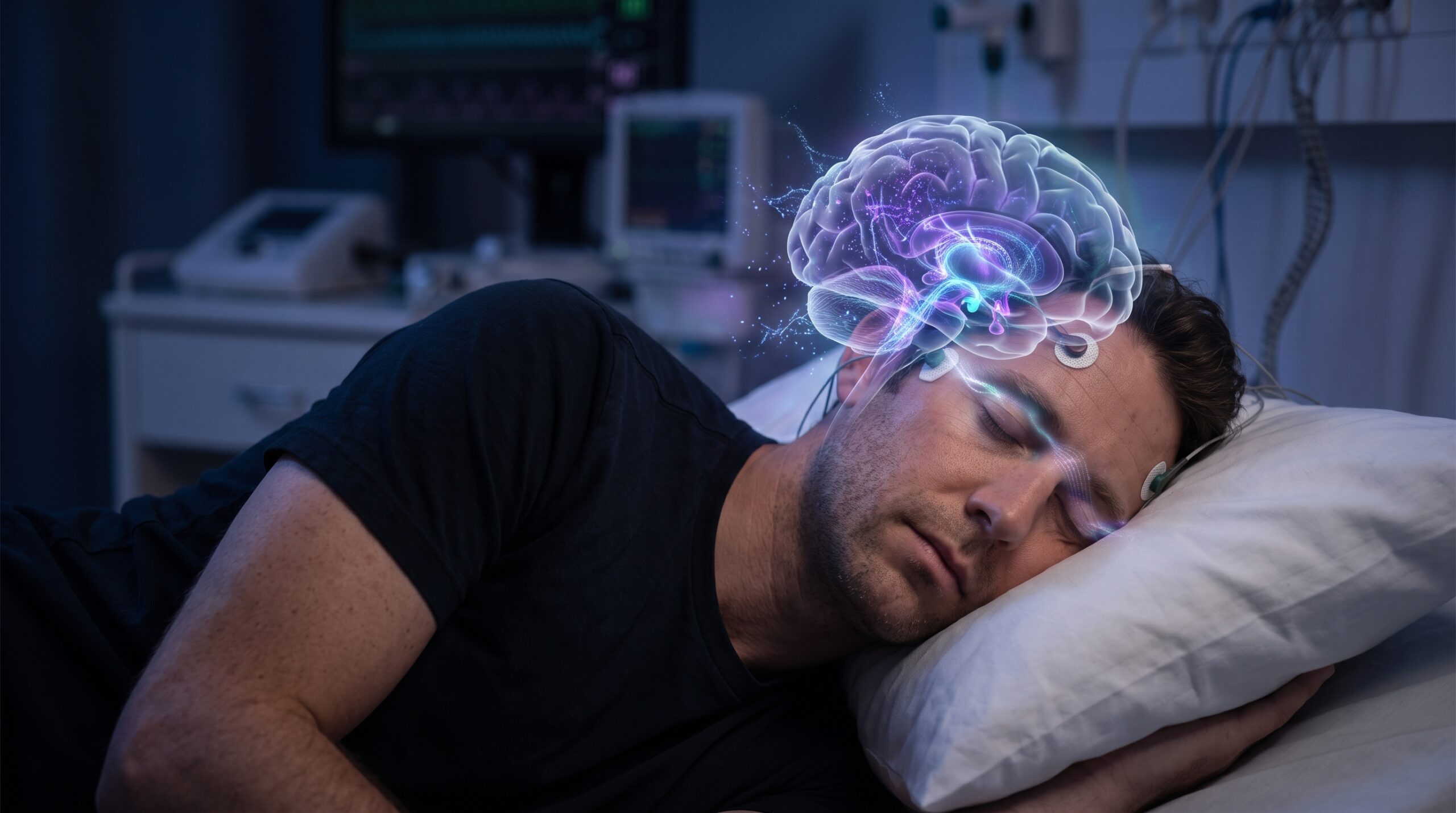
Rapid Eye Movement (REM) sleep is one of the most fascinating states of human biology. Every night, while you lie safely in bed, your brain enters a stage of intense electrical activity where your eyes dart beneath your eyelids, vivid story-like dreams unfold in your visual cortex, and your brainstem temporarily switches off your skeletal muscles so you don’t run or jump out of bed while dreaming. In a healthy brain, REM sleep is tightly locked behind a neurochemical vault door—only opening 90 minutes after you fall asleep and closing the instant you wake up.
In a person with narcolepsy, that vault door is broken off its hinges.
When asking, “How does narcolepsy affect REM sleep?”, the answer goes to the very heart of sleep neurology. Narcolepsy does not simply make a person sleepy; it fundamentally decouples and destabilizes the architecture of REM sleep. Instead of waiting 90 minutes to enter REM sleep at night, a brain with narcolepsy plunges into REM within minutes of closing the eyes. Worse still, individual pieces of REM sleep—like vivid dreams and full-body muscle paralysis—escape into broad daylight, ambushing the person while they are wide awake.
In this comprehensive guide, we will explore the exact neurochemical mechanisms of how narcolepsy affects REM sleep, why hypocretin loss breaks the brainstem’s REM control center, how REM intrusion causes cataplexy and hallucinations, the surprising link between narcolepsy and REM Sleep Behavior Disorder (RBD), and how modern medications restore normal REM boundaries.
Normal REM Sleep vs. Narcoleptic REM Sleep: What Changes?
To appreciate how dramatically narcolepsy alters REM sleep, let’s compare how a healthy nervous system manages REM sleep versus how a narcoleptic nervous system behaves across a 24-hour cycle.
How Normal REM Sleep Works
In a healthy adult without a sleep disorder:
- Strict 90-Minute Delay (Normal REM Latency): When you fall asleep at night, your brain must first travel through light Non-REM sleep (Stages N1 and N2) and deep slow-wave delta sleep (Stage N3). Only after 80 to 110 minutes does your brain enter its first brief episode of REM sleep.
- Back-Loaded REM Distribution: Your first REM period of the night lasts only 10 minutes. As the night progresses and deep N3 sleep finishes, REM periods grow longer, with the longest, most vivid REM stages occurring in the final two hours before morning awakening.
- Daytime Naps Rarely Contain REM: If a healthy, well-rested person takes a 20-minute afternoon power nap, they spend that nap in Stage N1 and N2 light sleep. They almost never reach REM sleep during a short nap.
- Synchronized State Boundaries: Dreaming, rapid eye movements, and muscle paralysis (REM atonia) occur only together and only while you are unconscious in REM sleep.
How Narcolepsy Transforms REM Sleep
In a person with narcolepsy, every single one of those rules is violated:
- Ultra-Short REM Latency (SOREMPs): Whether falling asleep at night or nodding off for a 10-minute nap at noon, the brain skips the 90-minute wait and plunges directly into REM sleep in 15 minutes or less (often within 60 to 180 seconds).
- State Dissociation (Splintered REM): The components of REM sleep split apart. Muscle paralysis can switch on while the person is wide awake and laughing (cataplexy), or dream imagery can project onto the bedroom wall while the person is still conscious (hypnagogic hallucinations).
- Fragmented Nocturnal REM: Despite entering REM sleep effortlessly, people with narcolepsy cannot maintain stable REM blocks at night. Their nocturnal REM sleep is riddled with micro-arousals, sudden shifts to wakefulness, and abnormal motor twitching.
| REM Sleep Parameter | Healthy Adult Sleeper | Adult with Narcolepsy |
|---|---|---|
| Nighttime REM Latency | 80 to 110 minutes | Often $\le$ 15 minutes (Nocturnal SOREMP) |
| Daytime Nap REM Entry | Virtually never in a 20-min nap | Enters REM in $\ge$ 2 of 5 short naps on MSLT |
| REM Muscle Atonia (Paralysis) | Strictly confined to asleep REM stages | Intrudes into wakefulness (Cataplexy & Sleep Paralysis) |
| Motor Control Inside REM | Complete skeletal muscle paralysis | Frequent loss of atonia (Twitching / REM Sleep Behavior Disorder) |
| Dream Intensity & Recall | Moderate; mostly recalled in late morning | Hyper-vivid, lucid, multisensory dreams during day & night |
| Total 24-Hour REM Percentage | ~20% to 25% of total sleep time | ~20% to 25% (redistributed across day naps & early night) |
The Neurobiology: Why Hypocretin Loss Breaks the REM Switch
Why does narcolepsy cause REM sleep to fire at the wrong time? To answer this, neuroscientists look at the circuit connecting the lateral hypothalamus to the pons (a critical relay station in the brainstem).
1. The Brainstem’s “REM-On” and “REM-Off” Neurons
Deep inside your pons, two rival groups of neurons control whether you are in REM sleep or not:
- The “REM-Off” Center: Located in the ventrolateral periaqueductal gray (vlPAG) and lateral pontine tegmentum (LPT), reinforced by norepinephrine neurons in the locus coeruleus and serotonin neurons in the dorsal raphe nucleus. When you are awake or in NREM sleep, these monoaminergic neurons fire continuously, pressing the brakes on REM sleep.
- The “REM-On” Center: Located in the sublaterodorsal nucleus (SLD) of the pons. When activated, SLD neurons fire glutamatergic signals downward to the medulla and spinal cord to paralyze your muscles (REM atonia) and upward to the visual cortex to generate dreams.
2. Hypocretin’s Job as the Master Gatekeeper
In a healthy brain, hypocretin-1 and hypocretin-2 (neuropeptides produced in the lateral hypothalamus) project directly onto the brainstem’s “REM-Off” center (the locus coeruleus, dorsal raphe, and vlPAG). Throughout the day, hypocretin excites these REM-Off neurons, locking the brakes on the REM-On center so that REM sleep cannot occur while you are awake or just drifting off to sleep.
3. When Hypocretin Disappears
In Narcolepsy Type 1, an autoimmune reaction wipes out 85% to 95% of hypocretin-producing neurons. Without hypocretin exciting the REM-Off center:
- Norepinephrine and serotonin tone plummets the moment you relax or experience a strong emotion.
- The brakes on the sublaterodorsal nucleus (REM-On center) fail completely.
- As a result, the REM-On switch flips prematurely—either within seconds of closing your eyes (creating a Sleep-Onset REM Period, or SOREMP) or in the middle of a waking laugh (creating cataplexy).
5 Specific Ways Narcolepsy Affects REM Sleep and Waking Life
Let’s examine the five distinct ways abnormal REM sleep manifests in people living with narcolepsy.
1. Sleep-Onset REM Periods (SOREMPs) and Instant Daytime Dreaming
The most measurable effect of narcolepsy on REM sleep is the SOREMP—entering REM sleep within 15 minutes of sleep onset. Because people with narcolepsy drop into REM sleep during brief daytime naps:
- A person who dozes off for just 3 to 5 minutes in a waiting room or on a commuter train can experience a full, complex, emotional dream.
- Because they enter and exit REM sleep so rapidly during brief naps, patients sometimes struggle with dream-reality confusion (dream delusions)—momentarily wondering whether a conversation they just dreamed during a 10-minute nap actually happened in real life.
2. Cataplexy: Waking Activation of REM Muscle Atonia
Cataplexy is perhaps the most dramatic example of how narcolepsy affects REM sleep circuitry. Normally, the sublaterodorsal nucleus (SLD) only triggers skeletal muscle paralysis while you are unconscious in bed.
- In Narcolepsy Type 1, positive emotional excitement (like laughing at a joke, making a witty comeback, or feeling sudden joy) activates the medial prefrontal cortex and amygdala.
- Without hypocretin to counterbalance the amygdala’s signal, the amygdala inhibits the brainstem’s REM-Off center and switches on the SLD’s REM muscle paralysis pathway while you are 100% awake.
- Deep tendon reflexes (like the knee-jerk reflex) completely vanish during a cataplexy attack—proving physiologically that cataplexy is literally REM sleep paralysis occurring during wakefulness.
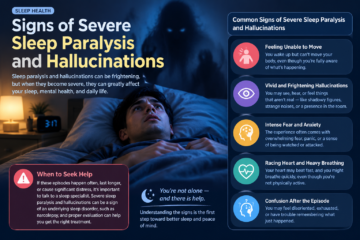
3. Sleep Paralysis: Delayed Termination of REM Atonia
While cataplexy is REM paralysis intruding into wakefulness during emotions, sleep paralysis occurs right at the border of falling asleep or waking up.
- When a person with narcolepsy wakes up from a REM stage, their cortical awareness switches on before the brainstem’s REM-On center shuts off muscle paralysis.
- For several terrifying seconds or minutes, the person lies frozen in bed, unable to move their limbs, open their eyes fully, or speak, often accompanied by a sensation of chest pressure because intercostal chest muscles are paralyzed while only the automatic diaphragm continues to breathe.
4. Hypnagogic and Hypnopompic Hallucinations: Waking REM Dreams
When REM sleep launches while a person is still partially conscious in bed (Stage W / Stage N1 transition), the visual, auditory, and tactile dream generators of REM sleep superimpose dream imagery directly onto the real bedroom environment.
- Visual hallucinations: Seeing people, animals, insects, or geometric shapes in the room.
- Auditory hallucinations: Hearing your name called, doors slamming, music, or footsteps.
- Kinetic/Vestibular hallucinations: Feeling as though you are levitating above the mattress, falling through the floor, or being touched.
5. Hyper-Vivid and Lucid Dreaming
Studies from sleep laboratories in Europe and the United States have shown that people with narcolepsy have a fundamentally different subjective experience of REM dreaming compared to healthy sleepers:
- Heightened Emotional Intensity: Because the amygdala and limbic system are hyperactive during narcoleptic REM sleep, dreams are often extraordinarily vivid, cinematic, and emotionally charged—leading to a higher frequency of recurrent nightmares.
- High Rate of Lucid Dreaming: Up to 70% to 80% of people with narcolepsy report regular lucid dreaming (knowing that they are dreaming while the dream is still happening, and often being able to consciously steer the dream plot). Why? Because their brain enters REM directly from wakefulness, preserving a thread of prefrontal cortical self-awareness inside the REM stage!
The Paradox: Why Narcolepsy Causes REM Sleep Behavior Disorder (RBD)
Here is one of the most surprising paradoxes in sleep medicine:
- During the day, people with narcolepsy have too much REM paralysis (cataplexy and sleep paralysis).
- Yet at night, inside actual REM sleep, up to 36% to 60% of people with narcolepsy have too little REM paralysis—a condition called REM Sleep Without Atonia (RSWA) or REM Sleep Behavior Disorder (RBD)!
How Can Both Happen in the Same Brain?
Remember that hypocretin acts as the master stabilizer of the REM switch—both keeping REM paralysis off when you are awake and holding REM paralysis firmly on while you are in nighttime REM sleep. Without hypocretin to stabilize the brainstem switch:
- During nighttime REM sleep, the muscle-paralysis switch flickers off intermittently.
- Instead of lying completely still during dreams, patients with narcolepsy experience frequent phasic muscle twitches, talking or shouting in their sleep, kicking, flailing their arms, or physically acting out their dreams in bed.
- Unlike age-related RBD (which typically affects men over 60 and is associated with alpha-synuclein neurodegenerative diseases like Parkinson’s), narcolepsy-related RBD occurs in young adults and children, is caused purely by hypocretin deficiency, and carries zero increased risk for Parkinson’s disease.
How Medications Target and Normalize REM Sleep in Narcolepsy
Understanding how narcolepsy affects REM sleep is critical for both diagnosis and treatment, because many medications directly alter REM sleep architecture.
1. Why You Must Stop Antidepressants Before a Narcolepsy Sleep Study
Many adults are prescribed SSRIs (like sertraline or fluoxetine) or SNRIs (like venlafaxine) for mood or anxiety before anyone realizes they have narcolepsy. These medications work by increasing serotonin and norepinephrine—which artificially stimulates the brainstem’s “REM-Off” center and suppresses REM sleep.
- If you take an SSRI or SNRI during your Multiple Sleep Latency Test (MSLT), the drug can block your SOREMPs and cause a false-negative test.
- Conversely, if you abruptly stop an antidepressant just two days before your sleep study, your brain experiences REM rebound (a massive surge of premature REM sleep), which can cause a false-positive test. This is why sleep specialists require a supervised 2-week (or longer for fluoxetine) medication washout before testing.
2. How FDA-Approved Narcolepsy Drugs Stabilize REM Sleep
- Oxybate Therapies (Xyrem, Xywav, Lumryz): Taken at night, oxybates act on $GABA_B$ receptors to dramatically increase deep slow-wave NREM sleep (Stage N3) and consolidate nighttime sleep architecture. By satisfying and stabilizing nocturnal sleep stages, oxybates stop REM sleep from spilling into the next day—eliminating up to 90% of cataplexy attacks, sleep paralysis, and hallucinations.
- Pitolisant (Wakix): By boosting histamine release in the tuberomammillary nucleus, Pitolisant strengthens waking cortical tone and inhibits inappropriate REM intrusions (cataplexy) during the day.
- SNRIs and Tricyclics (Venlafaxine, Clomipramine): Used specifically to boost norepinephrine and serotonin tone in the locus coeruleus, reinforcing the “REM-Off” switch to prevent cataplexy and sleep paralysis.
Conclusion
So, how does narcolepsy affect REM sleep? Rather than increasing the total amount of REM sleep you get in 24 hours, narcolepsy shatters the boundaries that keep REM sleep in its proper place. Due to the loss of hypothalamic hypocretin signaling, the brainstem’s REM-On switch fires within minutes of falling asleep (SOREMPs), projects vivid dreams into the twilight between waking and sleeping (hallucinations), triggers REM muscle paralysis during moments of laughter (cataplexy), and destabilizes motor paralysis during nighttime dreams (REM Sleep Behavior Disorder).
Recognizing these bizarre, often frightening experiences as mechanical misfires of the REM sleep stage lifts the stigma and fear surrounding narcolepsy—and paves the way for targeted neurological treatments that put REM sleep securely back into the night where it belongs.
FAQ
1. Do people with narcolepsy get more total REM sleep than normal people?
Surprisingly, no. Across a full 24-hour period, people with narcolepsy spend roughly the same total percentage of their sleep time in REM (~20% to 25%) as healthy sleepers. The difference is timing and fragmentation: instead of getting all their REM sleep in consolidated blocks during the second half of the night, their REM sleep occurs prematurely at the start of sleep (SOREMPs), during brief daytime naps, and in fragmented bursts throughout the night.
2. Why do people with narcolepsy have such vivid or lucid dreams?
Because a brain with narcolepsy transitions directly from wakefulness into REM sleep within minutes, parts of the waking prefrontal cortex remain partially active as the dream begins. This heightened cortical arousal makes dreams extraordinarily vivid, multi-sensory, and emotionally intense, and enables up to 80% of narcolepsy patients to experience regular lucid dreaming.
3. What is a SOREMP in narcolepsy?
A SOREMP (Sleep-Onset REM Period) occurs when a person enters the REM stage of sleep within 15 minutes or less of falling asleep (compared to the normal 80 to 110 minutes). Having two or more SOREMPs during a daytime Multiple Sleep Latency Test (MSLT) is a core diagnostic hallmark of narcolepsy.
4. Can narcolepsy cause you to act out your dreams at night?
Yes. Up to 60% of people with Narcolepsy Type 1 experience REM Sleep Without Atonia (RSWA) or REM Sleep Behavior Disorder (RBD). Because hypocretin is missing, the brainstem fails to hold muscle paralysis steady during nighttime REM sleep, causing patients to talk, kick, thrash, or act out dreams in bed.
5. How do antidepressants stop cataplexy and sleep paralysis?
Antidepressants like SNRIs (venlafaxine) and SSRIs (fluoxetine) increase levels of norepinephrine and serotonin in the brainstem. Because norepinephrine and serotonin directly stimulate the brain’s “REM-Off” neurons, these medications keep the brakes firmly applied to REM muscle paralysis while you are awake, preventing cataplexy and sleep paralysis.