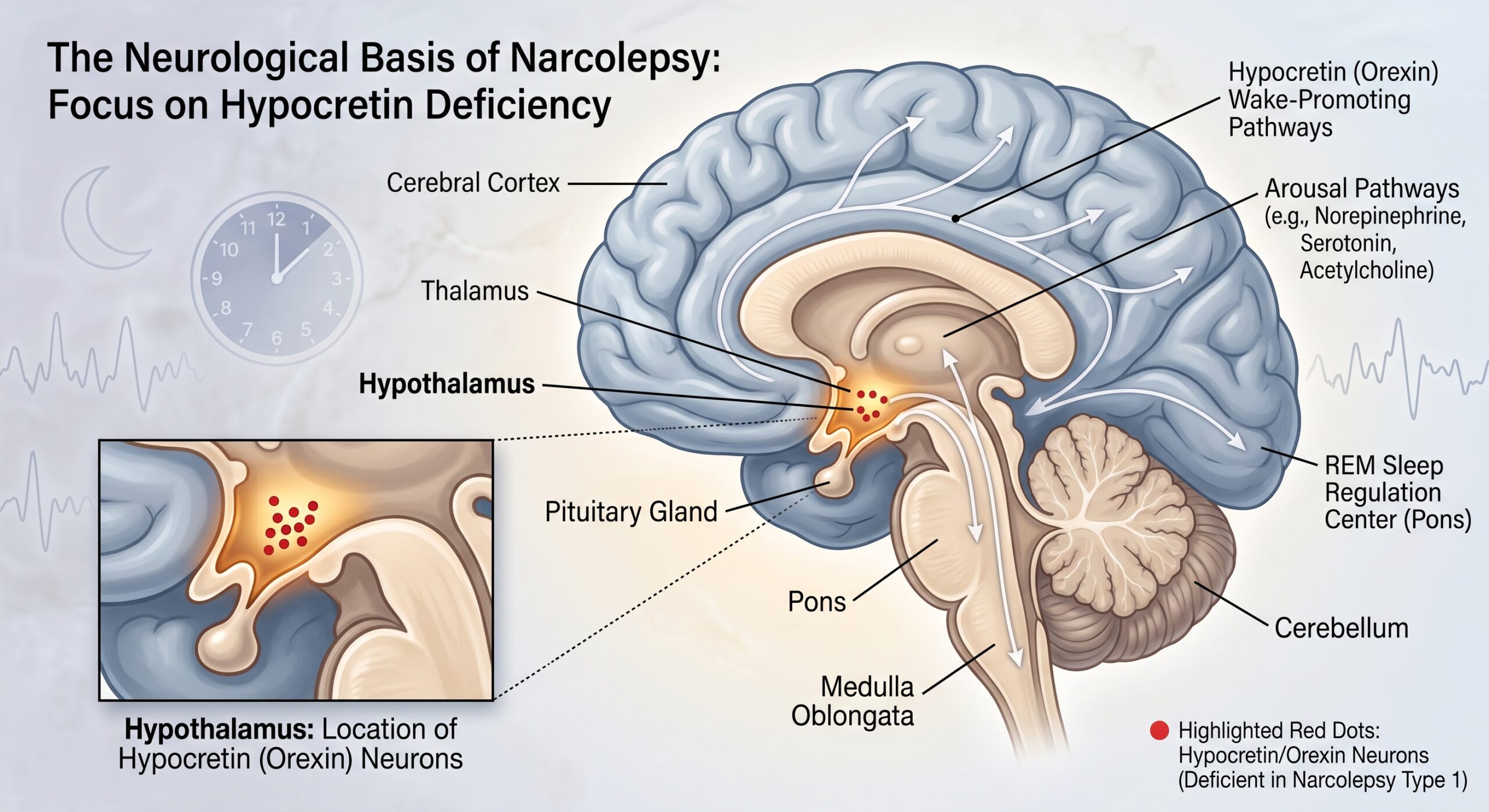
Narcolepsy is a neurological sleep disorder that can significantly affect the way a person stays awake, falls asleep, and moves between different stages of sleep. It is best known for excessive daytime sleepiness, but the condition can also involve cataplexy, sleep paralysis, vivid dream-like experiences around sleep, and disrupted nighttime sleep. Because these symptoms involve unusual changes in the sleep-wake cycle, many people wonder what part of the brain does narcolepsy affect and how changes in the brain can lead to these symptoms.
The brain controls the complex processes that determine when a person should be awake and when the body should enter sleep. Several interconnected brain regions work together to maintain alertness, regulate sleep stages, control muscle activity, and coordinate emotional responses. Narcolepsy is strongly associated with dysfunction involving the hypothalamus, particularly the loss or deficiency of neurons that produce a chemical messenger called orexin, also known as hypocretin. This system plays an important role in stabilizing wakefulness.
Understanding what part of the brain does narcolepsy affect can make the disorder easier to understand. Narcolepsy is not simply a condition in which someone becomes tired during the day. It involves changes in the brain mechanisms that regulate sleep and wakefulness. The effects can therefore involve several connected systems rather than one isolated area. Research into these brain pathways has helped scientists better understand why narcolepsy produces such distinctive symptoms.
What Part of the Brain Does Narcolepsy Affect?
The brain area most strongly associated with narcolepsy is the hypothalamus, particularly a region containing neurons that produce orexin or hypocretin. The hypothalamus is a relatively small but extremely important part of the brain. It helps regulate many essential functions, including sleep, wakefulness, appetite, body temperature, hormone activity, and other processes necessary for maintaining internal balance.
Within the hypothalamus are specialized neurons that release orexin. Orexin is a neurotransmitter involved in maintaining stable wakefulness and regulating the transition between sleep and being awake. In people with narcolepsy type 1, there is often a severe reduction or loss of these orexin-producing neurons. This loss is considered one of the most important biological features of narcolepsy type 1.
The answer to what part of the brain does narcolepsy affects therefore begins with the hypothalamus and the orexin system. However, the effects do not remain limited to the hypothalamus. Orexin-producing neurons communicate with multiple areas throughout the brain, including regions involved in arousal, emotion, muscle control, and sleep regulation. When orexin signaling is disrupted, several parts of the sleep-wake system can become less stable.
Understanding the Hypothalamus
The hypothalamus is located deep within the brain and has connections with many important neural systems. Although it is relatively small, it performs numerous regulatory functions. One of its major responsibilities is helping the body maintain a stable internal environment.
Sleep and wakefulness are among the functions influenced by the hypothalamus. The brain needs to coordinate numerous signals to keep a person awake during appropriate periods and allow sleep to occur when the body needs it. This process depends on communication between different brain regions and chemical signaling systems.
The hypothalamus contains several groups of neurons involved in sleep regulation. Some promote sleep, while others support wakefulness. These systems interact with one another to create relatively stable periods of sleeping and being awake.
Orexin-producing neurons are particularly important because they help stabilize wakefulness. Their signals reach areas of the brain involved in arousal and alertness. When these neurons are severely reduced, the brain may have greater difficulty maintaining a stable wakeful state.
This helps explain why narcolepsy can involve sudden and uncontrollable sleepiness. The problem is not necessarily that the brain is unable to produce sleep. Instead, the systems that normally stabilize wakefulness can become disrupted.
What Is Orexin or Hypocretin?
Orexin is a chemical messenger produced by a small population of neurons in the hypothalamus. It is also called hypocretin. The two names refer to the same signaling system.
Orexin has an important role in regulating wakefulness. It interacts with several areas of the brain that contribute to alertness, attention, motivation, and arousal. By influencing these systems, orexin helps keep the brain in a stable waking state.
In narcolepsy type 1, orexin levels in the brain and cerebrospinal fluid can be very low because the neurons responsible for producing orexin have been lost or severely reduced. This deficiency is strongly associated with the characteristic instability between sleep and wakefulness seen in narcolepsy.
The importance of orexin also helps explain why narcolepsy is considered a neurological disorder rather than simply a problem with sleep habits. Although sleep schedules and lifestyle can influence daytime sleepiness, the underlying biological changes in narcolepsy involve specialized brain systems.
Narcolepsy type 2 is different in that people generally do not have the same clearly demonstrated severe orexin deficiency that characterizes narcolepsy type 1. The exact biological mechanisms behind narcolepsy type 2 are less completely understood.
How the Brain Normally Controls Wakefulness
Being awake is an active biological state. The brain continuously receives information from the environment and maintains networks that support attention, movement, awareness, and responsiveness.
Several neurotransmitter systems contribute to wakefulness. The hypothalamus communicates with brainstem and other arousal systems to maintain alertness. Orexin neurons help coordinate these systems and make it easier for the brain to remain consistently awake.
During a normal day, wakefulness is generally maintained for extended periods. As the body approaches the natural sleep period, sleep-promoting mechanisms gradually become stronger. The transition into sleep is normally controlled and coordinated.
Narcolepsy can interfere with this stability. Without adequate orexin signaling, the boundaries between sleeping and waking can become less stable. A person may experience intense daytime sleepiness or unexpected transitions into sleep despite trying to remain awake.
This instability is one reason understanding the brain mechanisms behind narcolepsy is important. The condition is not simply about getting too little sleep. It can involve abnormal regulation of the states of consciousness themselves.
How Narcolepsy Affects the Sleep-Wake Cycle
The sleep-wake cycle depends on coordinated communication between several brain systems. Sleep is not one single state. It consists of different stages, including non-rapid eye movement sleep and rapid eye movement sleep.
During normal sleep, the brain moves through these stages in an organized pattern. REM sleep is associated with vivid dreaming, changes in brain activity, and temporary muscle paralysis that prevents most voluntary movements from being acted out during dreams.
Narcolepsy can cause elements of REM sleep to appear unusually close to the transition between wakefulness and sleep. This contributes to symptoms such as sleep paralysis and hallucination-like experiences around sleep.
The loss of orexin signaling can also make the boundaries between sleep and wakefulness less distinct. This may result in sudden sleep episodes, disrupted nighttime sleep, and other unusual transitions between different states.
The brain’s inability to maintain stable wakefulness is therefore an important part of the neurological basis of narcolepsy.
The Role of the Brainstem
The brainstem is another important part of the sleep-wake system. It contains networks that participate in arousal, consciousness, muscle control, and the regulation of sleep stages.
Orexin-producing neurons in the hypothalamus send signals to areas of the brainstem. These connections help regulate alertness and other aspects of the sleep-wake cycle.
Because the hypothalamus communicates with the brainstem, changes in orexin signaling can influence brainstem systems involved in wakefulness and REM sleep. This helps explain why narcolepsy symptoms can involve both excessive sleepiness and unusual REM-related phenomena.
The brainstem also participates in mechanisms controlling muscle tone. This becomes particularly relevant when considering cataplexy, one of the defining symptoms associated with narcolepsy type 1.
How Narcolepsy Is Connected to Cataplexy
Cataplexy is a sudden temporary loss of muscle tone while a person remains conscious. It is often associated with strong emotions and is particularly characteristic of narcolepsy type 1.
To understand cataplexy, it is useful to understand REM sleep. During REM sleep, the brain normally activates mechanisms that greatly reduce skeletal muscle activity. This temporary muscle inhibition helps prevent most voluntary movements during dreaming.
In narcolepsy, elements of REM-related muscle control can become active at inappropriate times. During cataplexy, a person may remain awake and aware while experiencing sudden weakness or loss of muscle control.
The condition therefore involves more than the hypothalamus alone. The hypothalamus, brainstem, emotional-processing systems, and motor-control pathways interact in ways that can become unstable when orexin signaling is severely disrupted.
The Connection Between Emotion and Narcolepsy
Emotions can influence many functions in the brain, including heart rate, attention, movement, and arousal. Narcolepsy can create an unusual connection between emotional activation and muscle control.
In cataplexy, strong emotions can trigger sudden changes in muscle tone. The precise mechanisms are complex, but researchers believe that abnormal interaction between emotional networks and REM-related muscle inhibition contributes to the phenomenon.
The amygdala and other emotion-related brain networks communicate with regions involved in arousal and motor control. Orexin signaling helps coordinate activity across these systems.
When orexin neurons are lost, this coordination can become less stable. As a result, emotional activation may sometimes be associated with sudden intrusion of REM-like muscle inhibition into wakefulness.
This is one reason narcolepsy is considered a disorder involving interconnected brain networks rather than damage to one isolated brain structure.
Sleep Paralysis and Narcolepsy
Sleep paralysis occurs when a person is temporarily unable to move while falling asleep or waking. It can be frightening because consciousness may return before normal voluntary muscle control has been restored.
The phenomenon is closely related to REM sleep. During REM sleep, natural muscle inhibition occurs. In narcolepsy, the transition between REM sleep and wakefulness can become less clearly separated.
When REM-related muscle inhibition overlaps with awareness, sleep paralysis may occur. The person may feel awake but temporarily unable to move normally.
This symptom further demonstrates how narcolepsy can involve abnormal regulation of sleep states. The underlying issue is not simply excessive sleep but instability in how the brain transitions between different states.
Hallucinations Around Sleep
Some people with narcolepsy experience vivid dream-like perceptions while falling asleep or waking. These experiences are often called hypnagogic hallucinations when they occur while falling asleep and hypnopompic hallucinations when they occur while waking.
These experiences can be highly realistic because they occur during transitions involving REM-related brain activity. Dream imagery may overlap with conscious awareness.
The presence of these experiences does not necessarily mean that a person has a psychiatric disorder. In the context of narcolepsy, they can be associated with unusual transitions between REM sleep and wakefulness.
Again, the underlying issue involves coordination among several brain systems. The hypothalamus and orexin system are central to the disorder, while brainstem and cortical networks participate in the broader sleep-wake transition.
Does Narcolepsy Damage the Brain?
Narcolepsy should not simply be described as widespread brain damage. The biological changes associated with narcolepsy are more specific.
In narcolepsy type 1, there is a major loss or severe reduction of orexin-producing neurons in the hypothalamus. This is a specific neurological change that affects the regulation of sleep and wakefulness.
The condition does not generally mean that the entire brain is progressively damaged. Many people with narcolepsy continue to have normal cognitive abilities, although excessive sleepiness and disrupted sleep can make concentration, memory, and daily functioning more difficult.
The distinction between neurological dysfunction and generalized brain damage is important. Narcolepsy changes the operation of specific sleep-regulating systems, but it is not accurately characterized as the brain deteriorating throughout the entire nervous system.
Why Are Orexin Neurons Lost?
Researchers believe that narcolepsy type 1 may involve an autoimmune process in which the body’s immune system mistakenly targets orexin-producing neurons. Genetic susceptibility appears to play an important role, and environmental factors may also contribute.
The precise chain of events leading to the loss of these neurons is still being studied. Research has identified associations with particular genetic factors and immune-system characteristics, but narcolepsy is not caused by one simple factor in every person.
The loss of orexin-producing neurons is nevertheless one of the clearest biological findings associated with narcolepsy type 1.
Because these neurons are relatively specialized, their loss can have a major effect on wakefulness despite involving a very small population of cells compared with the total number of neurons in the brain.
Narcolepsy Type 1 and Narcolepsy Type 2
Narcolepsy is commonly divided into type 1 and type 2. Narcolepsy type 1 is associated with cataplexy and, in most cases, significant orexin deficiency.
Narcolepsy type 2 involves excessive daytime sleepiness and other features of narcolepsy but does not usually include cataplexy. Orexin levels are generally not severely reduced in the same way as they are in narcolepsy type 1.
The distinction is clinically important because the underlying biology may differ. The exact cause of narcolepsy type 2 remains less clearly established.
Both types can cause significant daytime sleepiness and disrupted sleep, but they are not necessarily identical disorders at the biological level.
Can a Brain Scan Show Narcolepsy?
Routine brain scans such as MRI or CT generally cannot diagnose narcolepsy. This is because the primary abnormalities associated with narcolepsy type 1 involve specialized neurons and chemical signaling systems that are not typically visible on standard clinical brain imaging.
Diagnosis usually depends on a person’s symptoms, sleep history, and specialized sleep testing. Doctors may use overnight polysomnography and a Multiple Sleep Latency Test to evaluate sleep patterns and daytime sleepiness.
In selected situations, testing for cerebrospinal fluid orexin levels can provide additional information, particularly when narcolepsy type 1 is suspected.
Brain imaging may be used when a healthcare professional needs to investigate other neurological conditions, but a normal MRI does not rule out narcolepsy.
How Doctors Diagnose Narcolepsy
Diagnosing narcolepsy generally begins with a detailed medical and sleep history. A healthcare professional may ask about daytime sleepiness, unexpected sleep episodes, cataplexy, nighttime sleep, sleep paralysis, dream-like experiences, and other symptoms.
A sleep diary can help document sleep schedules and patterns over time. Wearable activity monitoring may sometimes provide additional information about sleep and wake patterns.
Overnight polysomnography is commonly used to monitor brain activity, breathing, heart rate, oxygen levels, and muscle activity during sleep. This test can help identify other sleep disorders and provide information about the structure of nighttime sleep.
The Multiple Sleep Latency Test is performed during the daytime after an overnight sleep study. It measures how quickly a person falls asleep during scheduled opportunities to nap and can also identify whether REM sleep occurs unusually soon after sleep onset.
In certain cases, cerebrospinal fluid testing can measure orexin levels. This can be particularly useful when the clinical picture suggests narcolepsy type 1.
How Narcolepsy Can Affect Concentration
Excessive daytime sleepiness can interfere with attention and concentration. Even when a person is actively trying to remain alert, the brain may struggle to maintain a stable level of wakefulness.
This can affect work, school, reading, conversations, driving, and other activities that require sustained attention. The difficulty does not necessarily mean that the person has lost intellectual ability. Instead, sleepiness can interfere with the brain’s ability to remain consistently engaged.
Repeated nighttime awakenings can also contribute to daytime fatigue. Narcolepsy can therefore affect both daytime alertness and nighttime sleep quality.
Managing narcolepsy effectively can help reduce the impact of these symptoms and improve daily functioning.
Does Narcolepsy Affect Memory?
Narcolepsy can be associated with difficulties in attention, concentration, and memory, particularly when excessive daytime sleepiness is severe. Poor sleep quality can make it harder to process and retain information.
However, narcolepsy should not automatically be interpreted as a disorder that causes progressive memory loss. The cognitive difficulties often relate to sleepiness, fragmented sleep, and difficulty maintaining alertness.
Researchers continue to study how narcolepsy influences cognitive performance and how treatment may affect attention and memory.
If someone experiences significant or worsening cognitive difficulties, a healthcare professional can help determine whether narcolepsy, another sleep disorder, medication, stress, or another condition may be contributing.
How Treatment Works With the Brain’s Sleep-Wake System
Treatment for narcolepsy is generally aimed at controlling symptoms and improving the stability of the sleep-wake cycle. There is currently no simple treatment that replaces the lost orexin-producing neurons in narcolepsy type 1.
Doctors may prescribe medications that promote wakefulness or reduce specific symptoms such as cataplexy. The appropriate treatment depends on the individual’s symptoms, health history, other medications, and clinical circumstances.
Behavioral strategies can also be important. Maintaining a consistent sleep schedule, planning appropriate naps, and practicing healthy sleep habits may support overall sleep management.
Treatment decisions should be made with a qualified healthcare professional because medications can have side effects and may interact with other treatments.
Why Understanding the Brain Matters
Knowing what part of the brain narcolepsy affects helps explain why the disorder produces such a distinctive collection of symptoms. The hypothalamus and its orexin-producing neurons play a central role in maintaining stable wakefulness.
The brainstem and other connected regions also participate in arousal, REM sleep, muscle control, and transitions between sleep and wakefulness. These interconnected systems help explain why symptoms can involve both excessive sleepiness and unusual REM-related experiences.
This understanding has also influenced research into new treatments. Scientists continue to study orexin pathways and other mechanisms involved in sleep regulation in the hope of developing more targeted therapies.
Narcolepsy is a neurological sleep disorder that affects the brain’s ability to regulate sleep and wakefulness. For reliable medical information about symptoms, causes, diagnosis, and treatment, readers can visit the National Heart, Lung, and Blood Institute (NHLBI) narcolepsy guide, which provides detailed information about the condition.
When to Seek Medical Evaluation
Persistent excessive daytime sleepiness should not automatically be assumed to be caused by a busy lifestyle or insufficient sleep. If sleepiness continues despite getting an appropriate amount of sleep, professional evaluation may be appropriate.
Sudden episodes of falling asleep, repeated sleep paralysis, vivid experiences around sleep, or episodes of sudden muscle weakness can also warrant discussion with a healthcare professional.
A sleep specialist can evaluate symptoms and determine whether further testing is appropriate. Other sleep disorders, medications, medical conditions, and lifestyle factors can produce daytime sleepiness, so an accurate diagnosis is important.
People who experience severe sleepiness should also take safety seriously, particularly when driving or operating machinery. Uncontrolled sleep episodes can create significant risks.
FAQ
What part of the brain does narcolepsy affect?
Narcolepsy is strongly associated with the hypothalamus, particularly the population of neurons that produces orexin or hypocretin. In narcolepsy type 1, these neurons are greatly reduced or lost, resulting in low orexin signaling. Because the hypothalamus communicates with many other sleep and wakefulness systems, the effects can extend across multiple brain networks.
Does narcolepsy affect the hypothalamus?
Yes. The hypothalamus is one of the most important brain regions associated with narcolepsy. Orexin-producing neurons located in the hypothalamus help stabilize wakefulness. Their loss is a major biological feature of narcolepsy type 1.
What happens to orexin in narcolepsy?
In narcolepsy type 1, orexin signaling is usually severely reduced because orexin-producing neurons have been lost. Low orexin levels can make it difficult for the brain to maintain stable wakefulness and regulate transitions between sleep and wake states.
Can an MRI diagnose narcolepsy?
A routine MRI generally cannot diagnose narcolepsy. Standard imaging may appear normal because the changes associated with narcolepsy involve specialized neurons and chemical signaling that are not usually visible on conventional brain scans. Diagnosis generally involves clinical assessment and specialized sleep testing.
Does narcolepsy damage the brain?
Narcolepsy is not generally considered widespread brain damage. Narcolepsy type 1 involves the loss of a specific population of orexin-producing neurons in the hypothalamus. The condition primarily disrupts sleep-wake regulation rather than causing generalized destruction of brain tissue.
Which chemical is associated with narcolepsy?
Orexin, also known as hypocretin, is strongly associated with narcolepsy. This neurotransmitter helps regulate wakefulness and sleep stability. Severe orexin deficiency is particularly associated with narcolepsy type 1.
Does narcolepsy affect memory?
Narcolepsy can interfere with attention, concentration, and memory performance, particularly when excessive daytime sleepiness or fragmented nighttime sleep is significant. These difficulties do not necessarily mean that narcolepsy causes progressive memory loss.
Why does narcolepsy cause cataplexy?
Cataplexy is thought to involve inappropriate activation of REM-related muscle inhibition during wakefulness. Loss of orexin signaling can disrupt the systems that normally stabilize wakefulness and control the boundaries between REM sleep and waking.
Conclusion
The answer to what part of the brain does narcolepsy affect centers on the hypothalamus and its orexin-producing neurons. These specialized neurons play a crucial role in maintaining stable wakefulness and coordinating communication between different brain systems involved in sleep and arousal.
In narcolepsy type 1, the severe loss of orexin-producing neurons is closely associated with excessive daytime sleepiness and cataplexy. The effects can also involve brain networks connected with REM sleep, muscle control, emotional processing, and arousal. This broader network helps explain symptoms such as sleep paralysis and vivid dream-like experiences around sleep.
Narcolepsy is therefore more than ordinary tiredness. It is a neurological sleep disorder involving the brain’s regulation of sleep and wakefulness. Although routine brain scans generally cannot diagnose it, modern sleep testing and clinical evaluation can help identify the condition. Understanding the role of the hypothalamus and orexin system continues to guide research into better ways of diagnosing and treating narcolepsy.