If you have spent months or years battling overwhelming daytime exhaustion, experiencing vivid dreams the moment your head hits the pillow, or feeling your knees buckle when you laugh, finally scheduling an appointment at an accredited sleep center can feel like a massive relief. At the same time, it is completely natural to feel nervous when you don’t know what to expect. You cannot diagnose narcolepsy with a routine routine blood panel at your family doctor’s office, nor will it show up on a standard brain MRI.
So, how do sleep specialists diagnose narcolepsy?
To confirm a clinical diagnosis of Narcolepsy Type 1 (NT1) or Narcolepsy Type 2 (NT2), board-certified sleep medicine physicians use a rigorous, standardized, multi-step protocol established by the American Academy of Sleep Medicine (AASM) in the International Classification of Sleep Disorders (ICSD-3-TR).
In this comprehensive guide, we walk you step-by-step through the entire diagnostic journey—from pre-test screening questionnaires and two-week actigraphy tracking to the overnight Polysomnogram (PSG), the gold-standard Multiple Sleep Latency Test (MSLT), CSF hypocretin-1 testing, and how to prepare so your results are 100% accurate.
Step 1: The Initial Clinical Evaluation and Sleep History
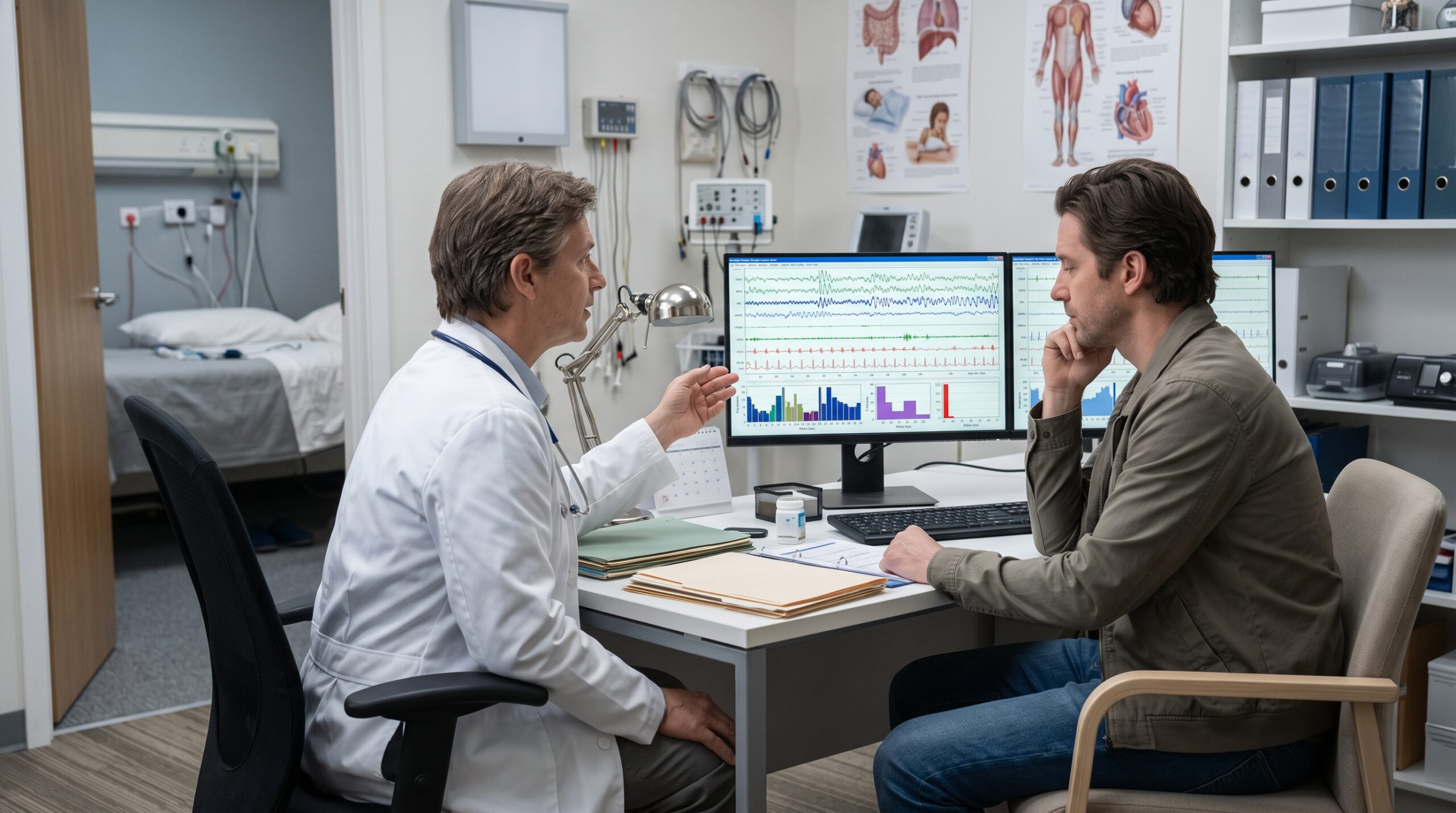
Before ordering expensive laboratory tests, a sleep specialist conducts a detailed 45-to-60-minute clinical interview. Because narcolepsy is frequently mimicked by other conditions, the physician looks for specific diagnostic patterns.
Screening Tools: Epworth Sleepiness Scale (ESS) and Swiss Narcolepsy Scale
During your first visit, you will complete validated clinical questionnaires:
- The Epworth Sleepiness Scale (ESS): Measures your likelihood of dozing off (rated 0 to 3) across eight sedentary situations, such as reading, watching TV, sitting in a meeting, or stopped in traffic. While healthy adults score 0 to 10, patients with untreated narcolepsy typically score 15 to 24.
- The Ullanlinna Narcolepsy Scale (UNS) & Swiss Narcolepsy Scale (SNS): Specialized clinical scales that weight both daytime sleep propensity and emotion-triggered muscle weakness (cataplexy), offering high sensitivity for identifying Narcolepsy Type 1.
Evaluating the “Narcolepsy Pentad” and Ruling Out Mimics
Your sleep specialist will ask targeted questions about all five core symptoms:
- Excessive Daytime Sleepiness (EDS): Have you experienced daily irrepressible urges to sleep for at least 3 consecutive months? Do short 15-minute naps temporarily refresh you?
- Cataplexy: Since doctors rarely see cataplexy in the clinic, they ask detailed questions about whether laughing, telling a joke, or feeling startled causes your jaw to slacken, eyelids to droop, speech to slur, or knees to buckle while you remain fully conscious. (Pro tip: If you have family videos capturing an episode, bring them to your appointment!)
- Hypnagogic/Hypnopompic Hallucinations & Sleep Paralysis: Do vivid visual, auditory, or tactile dreams intrude right as you fall asleep or wake up?
- Disrupted Nighttime Sleep: Do you wake up frequently throughout the night despite falling asleep quickly?
At this stage, your doctor may also order standard blood tests (thyroid panel/TSH, ferritin/iron stores, Vitamin B12, Vitamin D, and complete blood count) to rule out medical fatigue mimics.
Step 2: Crucial Preparation Before Your Sleep Lab Study (Don’t Skip This!)
One of the most important secrets to getting an accurate narcolepsy diagnosis happens during the two weeks leading up to your sleep study. If this step is mishandled, your test can easily produce a false negative or false positive.
1. Two-Week Sleep Logs and Wrist Actigraphy
Sleep specialists must prove that your daytime sleepiness is not simply caused by staying up until 2:00 AM every night (Insufficient Sleep Syndrome) or working rotating night shifts.
- For 14 days prior to your lab test, you will keep a daily Sleep Diary and often wear a medical wrist actigraph (a clinical-grade motion and ambient light sensor).
- You will be instructed to get a full, consistent 7.5 to 9 hours of sleep per night on a regular schedule leading up to test day.
2. Tapering Off REM-Suppressing Medications (The 14-Day Washout)
This is the #1 reason narcolepsy tests fail when ordered by non-specialists! Many common prescription medications artificially suppress REM sleep. If you are taking an antidepressant during your daytime nap test, the medication can block your brain from entering REM sleep during the test—causing the lab to miss your narcolepsy completely.
Under strict medical supervision, your doctor will typically taper you off the following medications at least 2 weeks (or 5 half-lives) before your sleep study:
- SSRIs and SNRIs: Fluoxetine (Prozac, which requires an even longer washout due to its long half-life), Sertraline (Zoloft), Escitalopram (Lexapro), Venlafaxine (Effexor), Duloxetine (Cymbalta).
- Tricyclic Antidepressants and MAOIs
- Stimulants and Wake-Promoting Agents: Adderall, Ritalin, Vyvanse, Modafinil, Armodafinil, Sunosi, Wakix.
- Sedatives, Benzodiazepines, and Recreational Cannabis/Alcohol
(Warning: Never stop antidepressants or stimulants cold turkey on your own, as this can trigger severe withdrawal or rebound cataplexy. Always follow your sleep physician’s tapering calendar.)
Step 3: Nighttime Polysomnography (PSG) — Part 1 of the Lab Test
To diagnose narcolepsy, you will spend roughly 20 to 22 hours at an accredited sleep center—arriving around 7:30 PM in the evening and leaving around 5:00 PM the following afternoon.
The first half of the testing is an overnight Polysomnogram (PSG).
What Happens During the Overnight PSG?
A registered polysomnographic technologist applies painless surface sensors to your body using gentle water-soluble paste:
- EEG (Electroencephalogram): Sensors on your scalp track exact brainwaves (alpha, theta, delta, and sleep spindles) to determine when you are awake and which stage of sleep (N1, N2, N3, or REM) you are in.
- EOG (Electrooculogram): Sensors near your outer eyes detect the rapid darting eye movements of REM dreaming sleep.
- EMG (Electromyogram): Sensors on your chin and shins measure muscle tone (detecting REM atonia as well as Periodic Limb Movements).
- Respiratory Belts, Nasal Cannula, and Pulse Oximetry: Measure airflow, snoring, chest effort, and blood oxygen saturation.
What Sleep Specialists Look For on a Narcolepsy PSG:
- 1. Ruling Out Obstructive Sleep Apnea (OSA): Ensures breathing pauses aren’t the real cause of your daytime sleepiness.
- 2. Sufficient Total Sleep Time: According to AASM guidelines, you must sleep at least 6 hours (360 minutes) during the overnight PSG for the next day’s nap test to be considered valid.
- 3. Nighttime SOREMP (Sleep-Onset REM Period): Healthy people take 90 minutes to enter REM sleep at night. If you enter REM sleep within ≤ 15 minutes of falling asleep on the overnight PSG, that counts as 1 official SOREMP toward your narcolepsy diagnosis!
- 4. Fragmented Sleep Architecture: Frequent brief awakenings, rapid stage shifts, and elevated muscle twitching during REM sleep.
Step 4: The Multiple Sleep Latency Test (MSLT) — The Gold Standard
The morning after your overnight PSG, the breathing belts and leg sensors are removed, leaving only the painless scalp (EEG), eye (EOG), and chin (EMG) wires attached. You are now ready for the Multiple Sleep Latency Test (MSLT)—the definitive diagnostic test for narcolepsy.
How the 5-Nap MSLT Protocol Works
Starting roughly 1.5 to 3 hours after you wake up from the overnight study, you will take 5 scheduled daytime nap opportunities, spaced every 2 hours throughout the day (for example: 8:00 AM, 10:00 AM, 12:00 PM, 2:00 PM, and 4:00 PM).
For each of the 5 naps:
- 1. You lie down in a dark, quiet, temperature-controlled bedroom.
- 2. The technologist turns off the lights and says over the intercom: “Please close your eyes and try to fall asleep.”
- 3. If you do NOT fall asleep: The nap trial ends after 20 minutes, and the lights come back on.
- 4. If you DO fall asleep: The technologist lets you sleep for exactly 15 minutes from the moment your brainwaves show sleep onset, carefully watching whether your brain enters REM sleep during that 15-minute window.
- 5. Between Naps: You must stay 100% awake and out of bed during the 1 hour and 40 minutes between each nap trial (no caffeine, no vigorous exercise, and no nodding off in the chair!).
Step 5: Interpreting Your Results — The Official ICSD-3 Diagnostic Criteria
When your sleep specialist analyzes the data from your overnight PSG and daytime MSLT, they calculate two crucial numbers:
- 1. Mean Sleep Latency (MSL): The average number of minutes it took you to fall asleep across all 5 naps.
- Healthy Adult Average: 10 to 20 minutes
- Narcolepsy Threshold: ≤ 8.0 minutes (Many narcolepsy patients average 1.5 to 4 minutes!)
- 2. Sleep-Onset REM Periods (SOREMPs): How many times you entered REM (dreaming) sleep within 15 minutes of falling asleep.
- Healthy Adult Average: 0 SOREMPs
- Narcolepsy Threshold: ≥ 2 SOREMPs (either 2+ during the daytime MSLT naps, OR 1 during the daytime MSLT + 1 on the previous night’s PSG).
| Diagnostic Parameter | Narcolepsy Type 1 (NT1) | Narcolepsy Type 2 (NT2) | Idiopathic Hypersomnia (IH) | Healthy Adult |
|---|---|---|---|---|
| Daily EDS Duration | ≥ 3 Months | ≥ 3 Months | ≥ 3 Months | None |
| Cataplexy Present? | Yes (or low CSF hypocretin) | No | No | No |
| Mean Sleep Latency (MSLT) | ≤ 8 minutes | ≤ 8 minutes | ≤ 8 minutes (or ≥660 min 24h sleep) | 10–20 minutes |
| Total SOREMPs (PSG + MSLT) | ≥ 2 SOREMPs | ≥ 2 SOREMPs | < 2 SOREMPs (0 or 1) | 0 SOREMPs |
| CSF Hypocretin-1 Level | ≤ 110 pg/mL (Deficient) | > 110 pg/mL (Normal) | > 110 pg/mL (Normal) | > 200 pg/mL |
Step 6: Biomarker & Genetic Testing (CSF Hypocretin-1 and HLA Blood Tests)
What if a patient cannot safely stop taking their antidepressants for two weeks before an MSLT, or what if the MSLT results are borderline? Sleep specialists have two powerful biological tools available:
1. Cerebrospinal Fluid (CSF) Hypocretin-1 Test (Lumbar Puncture)
Measuring hypocretin-1 (orexin-A) levels in the cerebrospinal fluid via a lumbar puncture (spinal tap) is the most definitive biological test for Narcolepsy Type 1.
- How It Works: If a patient’s CSF hypocretin-1 level is ≤ 110 pg/mL (or less than one-third of normal healthy control values), it confirms Narcolepsy Type 1 with >95% specificity—even without performing an MSLT!
- Big Advantage: Unlike the MSLT, CSF hypocretin-1 levels are not affected by antidepressants, stimulants, or sleep apnea.
- Limitation: Because patients with Narcolepsy Type 2 have normal CSF hypocretin levels (>110 pg/mL), a normal spinal tap only rules out NT1; it cannot rule out NT2.
2. HLA-DQB1*06:02 Genetic Blood Testing
Can a simple blood test diagnose narcolepsy? No—not by itself. However, your sleep specialist may order an HLA-DQB1*06:02 genetic blood test as a helpful piece of the puzzle:
- Why It’s Useful: Up to 98% of patients with hypocretin-deficient Narcolepsy Type 1 carry the HLA-DQB1*06:02 gene variant. If you test negative for HLA-DQB1*06:02, it makes classic autoimmune NT1 extremely unlikely (<2% chance).
- Why It Can’t Diagnose Alone: Roughly 12% to 25% of the completely healthy general population also carries the HLA-DQB1*06:02 gene and never develops narcolepsy. Therefore, a positive blood test only shows genetic susceptibility, not active disease.
5 Pro Tips for Patients Preparing for Their Narcolepsy Sleep Study
If your PSG and MSLT are coming up on the calendar, follow these five practical tips to ensure a smooth, stress-free experience:
- 1. Bring a Button-Down or Zip-Up Shirt: Once the technologist connects 20+ wires from your scalp to a small portable transmitter pack, pulling a tight t-shirt over your head is nearly impossible. Pack comfortable two-piece pajamas with a button-down top.
- 2. Bring Your Own Pillow and Blanket: Sleep lab beds are clean and comfortable, but having your own familiar pillow from home reduces the “first-night effect” and helps you easily hit the required 6-hour minimum sleep time on the overnight PSG.
- 3. Wash Your Hair With Plain Shampoo (No Conditioner or Gel): Scalp EEG electrodes need clean, oil-free skin contact to read your brainwaves clearly. Wash your hair the evening of the test and skip all hair oils, gels, sprays, and heavy skin lotions.
- 4. Plan Ahead for Meals and Entertainment Between Naps: The MSLT day is long! Bring non-caffeinated snacks/lunch (or confirm if the sleep clinic provides meals), and pack engaging activities like knitting, puzzles, or light reading to help you stay awake during the 100-minute breaks between naps.
- 5. Don’t Stress If You Feel Like You “Didn’t Sleep” During the Naps: Almost every narcolepsy patient walks out of their MSLT saying, “I’m worried I failed the test—I just lay there daydreaming with my eyes closed during all five naps!” Then, at their follow-up visit, they are shocked to learn they fell asleep in 2.5 minutes on every single nap and dreamed in four of them! Because narcolepsy causes instant dream intrusion (sleep state misperception), dreaming during a nap often feels exactly like lying awake thinking.
Conclusion
Understanding how do sleep specialists diagnose narcolepsy takes the mystery and anxiety out of the testing process. By combining a comprehensive clinical history of your daytime sleepiness and cataplexy with two weeks of consistent sleep tracking, an overnight Polysomnogram (PSG), and a five-nap Multiple Sleep Latency Test (MSLT) (or CSF hypocretin-1 testing), sleep specialists can pinpoint the exact neurobiological cause of your exhaustion.
Once your test results are in, you and your physician can move past years of guesswork and build a personalized treatment plan—using modern wake-promoting therapies, nighttime sleep consolidators, and lifestyle strategies—to help you thrive every single day.
FAQ
1. Can a neurologist diagnose narcolepsy without a sleep study?
In almost all cases, insurance providers and clinical guidelines require an objective overnight PSG and daytime MSLT to officially diagnose narcolepsy and approve specialty medications (like Wakix, Sunosi, Xywav, or Lumryz). The only official exception in the ICSD-3 criteria is for Narcolepsy Type 1 when a lumbar puncture directly confirms a CSF hypocretin-1 deficiency (≤ 110 pg/mL) alongside daily excessive daytime sleepiness.
2. Why do I have to stay awake between naps during the MSLT?
The MSLT measures how quickly your brain falls asleep and enters REM sleep at strict two-hour intervals. If you accidentally doze off in your chair between scheduled naps, it drains your built-up sleep pressure and REM pressure right before the official 20-minute nap trial begins, which can artificially lengthen your sleep latency and ruin the accuracy of the test.
3. What happens if I sleep less than 6 hours during the overnight PSG before my MSLT?
According to American Academy of Sleep Medicine (AASM) standards, a patient must achieve at least 6 hours of total sleep time on the overnight PSG so that daytime sleepiness on the next day’s MSLT isn’t simply caused by a bad night of sleep in the lab. If you sleep significantly less than 6 hours, the sleep clinic may have to cancel the next-day MSLT and reschedule the test.
4. What if I fall asleep in under 8 minutes on the MSLT, but I have zero SOREMPs?
If your overnight PSG rules out sleep apnea and your daytime MSLT shows severe objective sleepiness (a Mean Sleep Latency of ≤ 8 minutes), but you have 0 or only 1 SOREMP (and no cataplexy), your sleep specialist will typically evaluate you for Idiopathic Hypersomnia (IH)—a closely related central disorder of hypersomnolence that shares many treatments with narcolepsy (including Xywav and Modafinil) or may order a repeat MSLT down the road.
5. Does health insurance cover the PSG and MSLT for narcolepsy?
Yes, most private health insurance plans, Medicare, and Medicaid cover an in-lab overnight Polysomnogram (PSG) and next-day Multiple Sleep Latency Test (MSLT) when ordered by a physician for documented chronic Excessive Daytime Sleepiness (lasting ≥3 months) and suspected narcolepsy, though prior authorization and a normal home sleep apnea screen are sometimes requested first depending on your insurer.